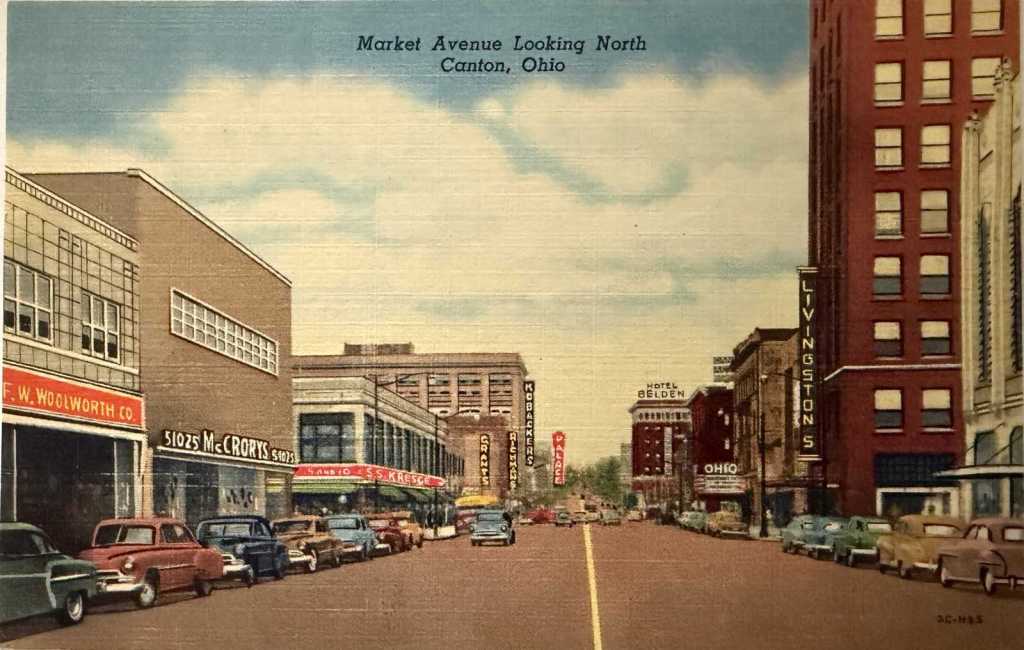
This 1950s postcard scene of downtown Canton, Ohio, shows an F.W. Woolworth Co., a McCrory’s, a Kresge’s and a Grant’s store all lining the left side of Market Street.
By Ken Drenten
This is the second of two parts about retailers that were around (and some that are still around) in Columbus and central Ohio in the latter part of the 20th century, or as some people now call it, “The 1900s.” (Since I have lived well over half my life in the 1900s, I feel so old…)
McCrory’s – McCrory’s Stores were founded in 1882 by J.G. McCrorey with a five-and-dime store in Scottsdale, Pa. (The spelling of “McCrorey” was changed to “McCrory” for the stores.) By the early 1930s the chain headquartered in York, Pa., had 244 stores; it entered bankruptcy in 1933. One of the post-bankruptcy investors was S.S. Kresge, but the chain resumed operations as McCrory’s. Over the years, McCrory’s bought out many competitors, becoming the nation’s fourth-largest retailer by 1963. At its height in 1989, McCrory’s operated 1,300 stores as McCrory’s and TG&Y. The company filed for bankruptcy in 1992; the company ceased operations in early 2002.
Montgomery Ward – Montgomery Ward was founded in 1872 in Chicago by offering the new concept of catalog mail-order shopping. By 1883 its catalog had grown to 240 pages and 10,000 items. The company launched its first retail store in 1926 in Plymouth, Ind., with the number of stores peaking at 531 in 1929, and the company continued its mail-order catalog business.
By the end of the 1930s, Montgomery Ward was the nation’s largest retailer; through the 1940s to 1960s it was the third-largest retailer in the U.S. In 1985 the company ended its catalog business and focused on renovating retail stores. In 1997, store logos were changed to read simply “Wards.” I could be wrong, but I think there was a Montgomery Ward store in the Town & Country Shopping Center on E. Broad Street.
The company filed for bankruptcy in 2000; laid off 37,000 employees and closed 250 remaining retail stores in 2001. The brand was acquired in 2004 by a direct marketing company, Direct Marketing Services Inc. (DMSI), which relaunched Montgomery Ward as an online and catalog-based business which continues today (https://wards.com). DMSI was itself bought out by Swiss Colony in 2008, which now operates Montgomery Ward.
Murphy’s Mart/G.C. Murphy – This was a chain of five and dime or variety stores operating from 1906 to 2002, founded in McKeesport, Pa. They also operated Murphy’s Mart (full-scale discount stores), Bargain World (closeout merchandise), Terry & Ferris and Bruners (junior department stores), and Cobbs (specialty apparel) stores. The chain had a peak of 448 stores in 1980. In April 1985, the company was acquired by Ames Department Stores Inc. Ames converted many of the larger Murphy’s Mart stores and in 1989, sold the variety store division to former competitor McCrory Stores.
Ontario’s – Ontario’s Super Mart was initially a Lorain, Ohio-based discount retail chain that began in the 1950s selling clothing, groceries, hardware, electronics and household goods. In 1964, the nine-store chain was acquired by Cook Coffee Co. of Maple Heights, Ohio, which would become Cook United Inc. Cook also operated Cooks, Whitehall Discount City and other branded stores. The chain grew to 82 stores by 1975; during this time Cook also acquired Rink’s Bargain City. The Ontario name was dropped in 1981 and stores were closed or converted to Rink’s stores. Cook closed operations completely by 1987. There was an Ontario’s store near Eastland Mall on S. Hamilton Road, which I think became a Marshalls store in more recent years. I don’t know what’s there now.
Rink’s – Rink’s was founded in Hamilton, Ohio, in 1951 and was acquired by Gray Drug Co. in 1964. The chain was known for deep discount merchandise, including clothing, housewares, tools and toys. Bargain City was acquired by Gray Drug in 1967, and some stores were known as Rink’s Bargain City. Both chains were sold to Cook United in 1981 and were closed in 1987. There was a Rink’s store on E. Livingston Avenue just west of Courtright Road. One former Rink’s store in Marietta now does business as Rinky Dink Flea Market.
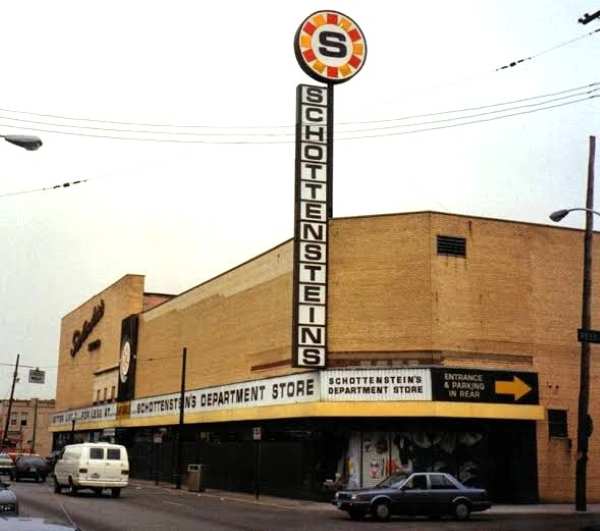
Schottenstein’s Department Store on S. Parsons Avenue closed in 2006.
Schottenstein’s/Value City – Schottenstein’s is another major name in Columbus retailing. The chain was founded in 1917 with a single store at 1887 S. Parsons Avenue, and soon opened others around Columbus. The company acquired Value City department stores in 1962. Columbus-area stores were branded as Schottenstein’s, while stores outside the Columbus market were branded as Value City.
The stores focused on clothing, home goods and jewelry below manufacturers’ retail prices, with buyouts, closeouts, irregular and factory seconds merchandise. The firm sold Value City Department Stores in 1991, and the original Schottenstein’s store on Parsons Avenue closed in 2006. Other company interests included Value City Furniture (which continue to operate today), Shiffren Williams jewelry stores and Sara Fredericks boutiques. There’s a Value City Furniture store on E. Main Street in Reynoldsburg.
The Schottenstein family has contributed greatly to the Columbus and The Ohio State University community, most notably with the Schottenstein Center (“The Schott”) and Value City Arena at Ohio State.
Sears – For a very long time, Sears was as American as apple pie. Sears, Roebuck & Co. was founded in 1892 in Chicago and reincorporated in 1906; the company began as a mail-order catalog business and expanded into retail stores starting in 1925. Sears was famed from 1908 to 1940 for its ready-to-assemble house kits; from 1933 until the 1990s, it was known for its annual “Wish Book” Christmas catalogs.
Sears stores were located in downtowns across the country, and from the 1960s on, Sears provided solid anchor stores for enclosed malls across the nation. Through the 1980s, Sears was the largest retailer in the U.S. but was surpassed in the late 1980s by Walmart. Sears merged with Kmart in 2005, and the parent company filed for bankruptcy in 2018.
From its peak of 2,705 stores in 2011, there were only five U.S. stores remaining open as of December 2025. Its reputable store brands Kenmore (appliances), Craftsman (tools, lawn mowers and equipment), Diehard (car batteries) and Allstate (insurance) have survived through other retailers.
Service Merchandise – Service Merchandise had a unique approach to retail. Each store was essentially a showroom with an attached warehouse. Customers would choose items in the showroom, receive an order form, then walk over to a checkout counter, pay for the item and wait for it to appear on a conveyor belt from the warehouse. The stores specialized in jewelry, unique toys, sporting goods and electronics. The chain started in 1934 as a five-and-dime store in Pulaski, Tenn., hit its stride in the 1970s and ‘80s but ceased operations by 2002.
Swallen’s – Swallen’s was a merchandise, electronics and appliance store based in Cincinnati that opened in 1948. The company filed for bankruptcy in 1995 and all stores closed by the end of the year. The Swallens store I remember was located in the old Whitehall Discount City store at E. Main Street and S. Hamilton Road. I bought a great number of LP records at the Swallen’s store in Whitehall.
The Union – The Union opened in 1894 as a gentleman’s clothing store, adding women’s fashions in the 1910s. The store was located in a tall white building along S. High Street in downtown Columbus and moved directly across the street from Lazarus in 1968. The store closed in 1980 and the building was demolished in 1986 for construction of the City Center Mall. The Union had several stores in suburban locations as well as the flagship downtown store.
Whitehall Discount City – I don’t remember much about this discount store and there is little to nothing about it on the Internet, but I remember it was located on E. Main Street near S. Hamilton Road in Whitehall. At some point in the 1970s, the store became Swallen’s. The property is now The Buckeye Ranch.
Woolworth/Woolco/Foot Locker – The F.W. Woolworth Co. was the pioneer and the best-known merchandiser that started as a five-and-dime store. Founded in 1879 in Utica, N.Y., Woolworth became one of the biggest retailers of the 20th century, with 596 stores by 1912. Woolworth’s was also well-known for its diner-style lunch counters in many stores.
Woolco stores were developed in 1962 as “super-stores” to compete with Kmart and other suburban discount stores. The chain purchased the Kinney Shoe Corp. in 1963 and founded The Foot Locker in 1974. In 1979 Woolworth became the biggest retailer in the world. But failures followed quickly. Decline led to restructuring and closure of half of its 800 U.S. Woolworth stores by 1993.
Woolco stores had closed by 1983. I remember going to the Woolco store on E. Broad Street in Whitehall after Christmas in 1982 with my father and grandfather to shop the going-out-of-business bargains. I bought a Swiss Army knife that I still have today. In the late 1990s, the company continued closing its department stores and converted many to Foot Locker stores. In 2025, Dick’s Sporting Goods purchased Foot Locker.
Zayre – Zayre discount stores were founded in 1956 in Framingham, Mass. By 1966, the chain had 92 stores operating in Chicago, Miami, Boston and other markets including Columbus. In 1977, Zayre branched into specialty women’s apparel, launching T.J. Maxx stores. Zayre also originated the Hit or Miss (1980s-2001) and B.J.’s Wholesale Club (1984) chains.
Zayre’s stores operated until a corporate reorganization and buyout by Ames in 1988, and all Zayre’s stores were sold, closed, or converted to Ames in 1990. Its descendant TJ Maxx continues to operate some 1,000 stores in the U.S., selling men’s, women’s and children’s apparel and shoes, toys, bath and beauty products, accessories, jewelry, and home products ranging from furniture and decor to housewares and kitchen utensils. To the best of my recollection, the Zayre store on E. Main Street in Whitehall became a Service Merchandise store. Today, the space is taken up by a Walmart store.
Ken Drenten is creator and editor of Dusty-Tires.com, a travel blog for out-of-the-ordinary places in Ohio.
Share Dusty Tires with a friend; your likes and comments are appreciated. Be sure to check out the Dusty Tires YouTube channel. And subscribe to Dusty Tires and receive a weekly email with the latest blog article. It’s free!
All rights reserved, Dusty Tires (dusty-tires.com), 2026.


Leave a Reply