
Sadly, this former Ben Franklin store in Carrollton closed in 2025. (Credit: Ken Drenten)
By Ken Drenten
The recent post about former restaurants was pretty popular with readers, so I decided to do a similar roundup of former department, discount and variety stores that I remember from the Columbus and central Ohio area. And let me tell you, there are a boatload of them.
With the advent of the internet, Amazon and other online retailers and large-scale retailers like Walmart, retailers have been closing up shop for many years. But the demise of brick-and-mortar stores started long before current times.
Most of these retailers followed a similar boom-and-bust cycle with glory years and expansion from the 1920s to mid-century followed by steadily declining sales and bankruptcy in the late 20th century and the early 21st century.
In fact, it was alarming how quickly and consistently most of these retailers hit their peaks and then plunged, due to mismanagement, over-expansion, specialization errors, failure to adapt to changing market conditions and the rise of the Internet. And the retail market was – and is – a voracious dog-eat-dog one, with companies consuming each other left and right.
I learned in my research that TJ Maxx stores are direct descendants of the Zayre chain of discount stores, and that Foot Locker (now part of Dick’s Sporting Goods) was owned by Woolworth’s. And I was reminded that many retailers, such as Lazarus, Big Lots, Gold Circle, Elder-Beerman, Hills, Schottensteins/Value City and Swallens, originated in Ohio.
For a list of general and variety merchandise stores in Ohio, including several historic ones, see Dusty Tires’ General Stores listings.
Here are some that were present in the Columbus and central Ohio area. If you can think of any others, let me know in the comments.
Ames – This discount retail chain was founded in 1958, based in Rocky Hill, Conn. At its peak, Ames operated 700 stores in 20 states including Ohio. Ames purchased the Kings, G.C. Murphy and Zayre chains in the 1980s, and in 1998 acquired the Hills chain, but went into bankruptcy and closed or sold all locations in 2002.
Ben Franklin – Ben Franklin originated in 1877 as Butler Brothers and became Ben Franklin Stores in 1927, based in Mount Pleasant, Wis. Owners underwent bankruptcies in 1997 and 2017 but a number of remnant locations, including several in Ohio, have continued to operate under various names. Ben Franklins were well-known for their “five and dime” variety merchandise, crafts, fabrics and hobby supplies. A former Ben Franklin in Carrollton, known as Ashton’s 5 & 10 Cent Store, closed in 2025 after having been in business since 1932. HMSPartners acquired the company and continues to operate some Ben Franklin Crafts stores.
Big Lots/Odd Lots – Big Lots, initially known as Odd Lots, is a deep-discount store chain founded in 1967 by Consolidated Stores in Columbus. At its height in 2024, there were 1,300 Big Lots stores in the U.S. The company filed for bankruptcy in 2024 and most stores closed down, but several hundred were purchased by Variety Wholesalers and reopened to operate as Big Lots. More than 50 other former Big Lots stores were purchased by other buyers including Ollie’s Bargain Outlets. Today, Variety Wholesalers operates 217 Big Lots stores in the Midwest, Southeast and Mid-Atlantic, including four around Columbus.
Buckeye Mart – These discount stores were owned by Gamble-Skogmo, founded in 1925 and headquartered in St. Louis Park, Minn. The stores were known as Tempo stores elsewhere in the Midwest, but in Ohio, they were called Buckeye Mart in the 1960s and 1970s. The Berwick Plaza Buckeye Mart became the first Big Lots store in the Columbus-based company’s chain. Stores in Ohio and Michigan were sold to Fisher’s Big Wheel in the late 1970s; most of these stores were closed in the 1980s.
Elder-Beerman – Elder-Beerman was an Ohio-based chain of department stores founded in 1883 whose last stores closed in 2018. The chain, based primarily in the Midwest, was composed of 31 stores in eight states at the time of its liquidation. The chain was headquartered in Moraine, Ohio, with a flagship location in downtown Dayton.
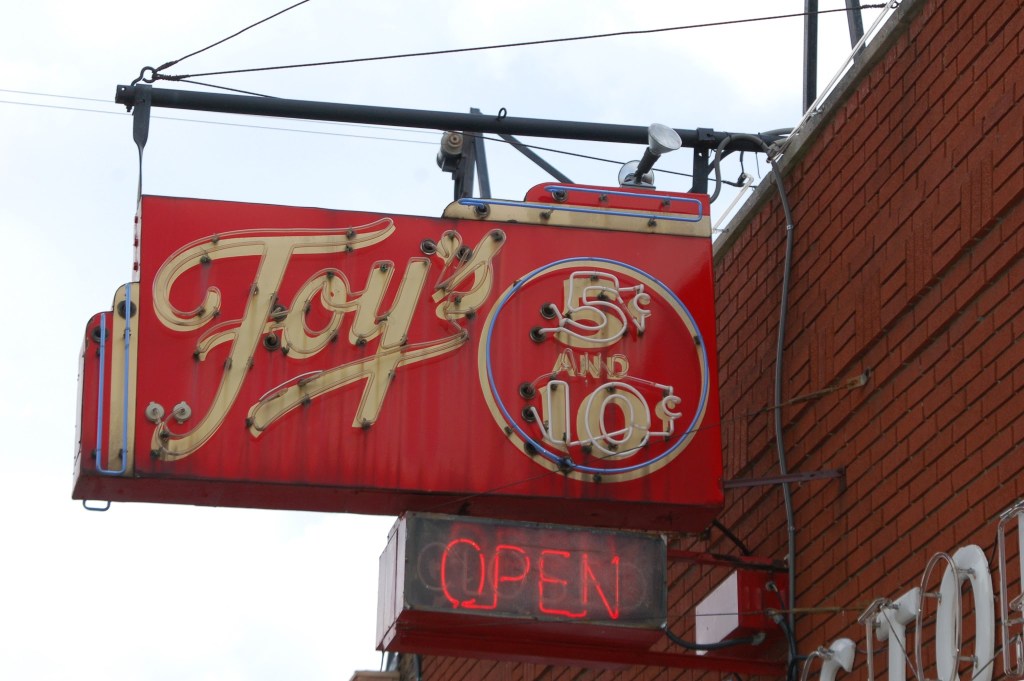
Foy’s began in 1929 as a five-and-dime store but now specializes in Halloween themed items. (Credit: Ken Drenten)
Foy’s – Foy’s began in 1929 as a five-and-dime store in Fairborn, Ohio. The original store at 18-20 E. Main St. in Fairborn is now one of a local chain of Halloween-themed stores open all year long in the Dayton area. Foy’s Halloween Stores have costumes, decorations, lighting and everything else you can think of to have a successfully scary Halloween.
Gold Circle – Gold Circle was a discount department store chain based in Columbus, Ohio. Founded in 1967, it was a division of Federated Department Stores with 76 stores when the chain was sold and dismantled in 1988. Gold Circle managed to fill the midrange marketing space between high-end and true discount retailers, pretty much what Kohl’s and Target do today. After acquisition in the late 1980s, some former Gold Circle stores became Hills, Target or Kmart stores. Gold Circle stores were typically located near mall locations in Columbus, including near Eastland Mall.
W.T. Grant – W.T. Grant or Grants stores were founded in Lynn, Mass., in 1906. Stores were mostly located in traditional downtown storefronts and later in suburban shopping centers such as Great Eastern Shopping Center in Whitehall. They were true variety merchandise stores, reminiscent of the “five and dime” format of earlier years. By 1972, the chain had grown to 1,200 stores but went into bankruptcy in 1976.
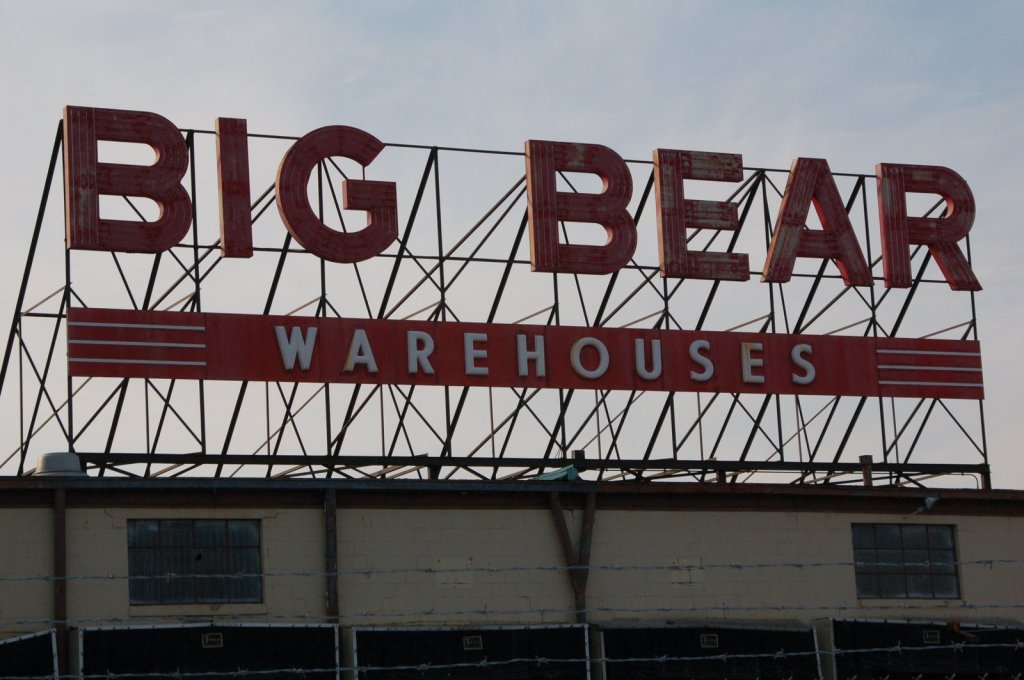
Harts stores were typically attached to Big Bear grocery stores. Big Bear Warehouses sign near Grandview Heights shown above. (Credit: Ken Drenten)
Harts – Harts Family Center department stores were usually connected to Big Bear grocery stores. Big Bear, based in Columbus, purchased Harts in 1954. The chain reached its peak in the late 1980s, but Big Bear began to phase out Harts in favor of a more seamless “Big Bear Plus” format in the 1990s. After acquisition, Big Bear itself shut down all its stores by 2004.
Heck’s – Heck’s was a chain of discount stores based in Charleston, W.Va., with locations in the Midwest including those in Ohio, typically in smaller cities. Established in 1959, the chain reached its peak in the 1980s with 170 locations. A late 1980s bankruptcy led to closure of most stores by the early 1990s.
Hills – Hills was established in 1957 in Youngstown. In 1989, Hills purchased many former Gold Circle locations. In 1998, Hills had 155 locations in 12 states with more than 20,000 employees. The department store chain went into bankruptcy and was acquired by Ames in 1999.
Kresge/Kmart – The S.S. Kresge Company was founded in 1897 by a traveling salesman with one store in Memphis, Tenn. At one time Kresge was one of the 20th century’s largest discount retailers. The chain had 642 stores by 1940. In the 1960s, the first Kmart stores appeared, and some stores were rebranded as Jupiter Discount Stores. Due to changing economic patterns the company changed its name to Kmart Corporation in 1977 and gradually changed remaining Kresge stores to Kmarts. By 1982 there were 2,055 Kmart stores across the U.S. and Canada. Kmart was well-known for the “Blue Light Special,” a temporary price discount marked by a store announcement and a flashing blue light in the area where the item could be purchased.
The first Super Kmart Center, adding groceries, deli and bakery items to regular merchandise, opened in 1991. Another new store format, focusing on home fashions, childrens’ apparel and consumables, followed in 1997, named Big Kmart. The company filed for bankruptcy in 2002; at that time it operated 2,114 stores across the U.S. and several U.S. territories and employed 275,000 people. Store closures followed, and in 2005 Kmart merged with Sears in a blockbuster deal worth $11 billion.
Nearly two decades of struggle followed with steady closures of both Kmart and Sears stores and purchase of Kmart and Sears by a holding company in 2019. By 2025, all but a few Kmart or Sears stores had closed. Reportedly there is one store open in Miami with two others in U.S. territories.
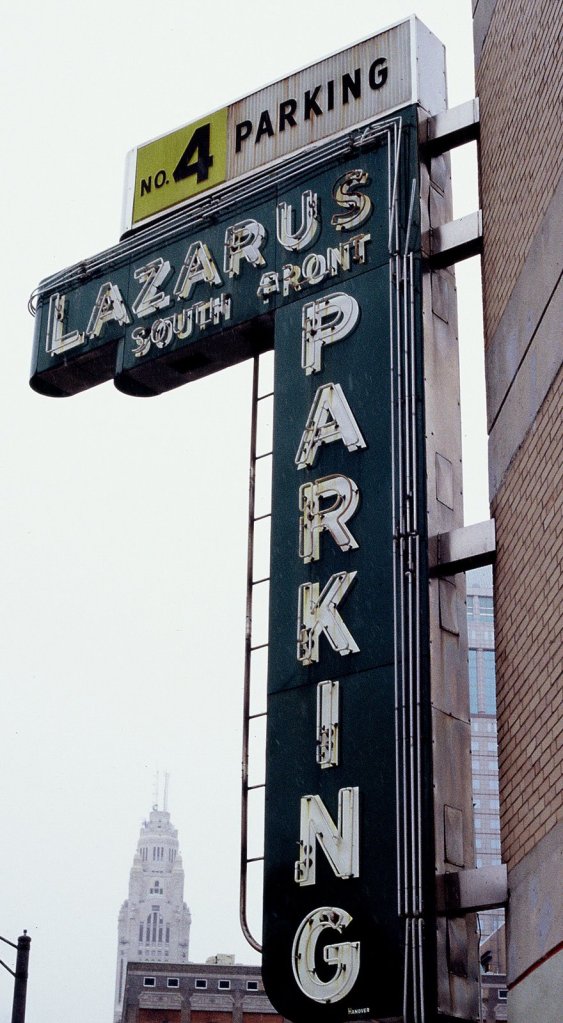
This sign from Lazarus’ parking garage in downtown Columbus remained as a reminder of the influential store chain (Credit: Ken Drenten)
Lazarus – Certainly the most influential and fondly remembered department store chain in Columbus, Lazarus was founded in Columbus in 1851 by Simon Lazarus. His sons Fred and Ralph followed him into the business, and the company became known as the F. & R. Lazarus Company. Lazarus was a founding partner in Federated Department Stores in 1929. Over the years, Federated acquired or merged with retailers Foley’s, Shillito’s, Filene’s, Macy’s and others, and developed the Gold Circle chain.
Lazarus was a dominant player in the Midwest and national retail space and in the Columbus community. The downtown store’s annual Christmas storefront displays and Santa Claus visits were much anticipated each holiday season. Lazarus was known for no-haggle pricing and a generous return policy; it pioneered in-store escalators (1909) and in-store air conditioning (1934). In addition, it was Fred Lazarus, Jr.’s lobbying that convinced President Franklin D. Roosevelt in 1939 to permanently make Thanksgiving Day the fourth Thursday of November, ensuring a consistent annual start to the Christmas retail season. The Lazarus family was also well known for their philanthropy, most notably in helping found what is now Nationwide Children’s Hospital.
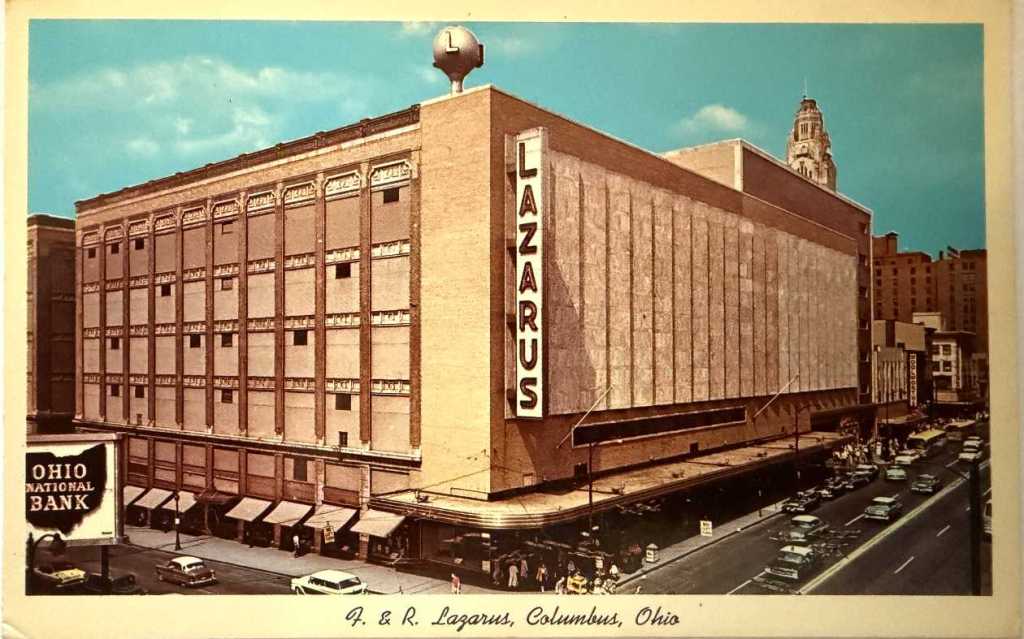
This 1950s postcard shows the F.&R. Lazarus Co. flagship store in downtown Columbus.
Lazarus not only had its six-story flagship store in downtown Columbus but developed stores in suburban malls in the 1960s. True Lazarus aficionados remember the Lazarus Basement where bargains could be had, the Chintz Room restaurant, and the Lazarus outlet store on W. Whittier Street. Following a bankruptcy filing in 1990, a steadily softening retail market and consolidation under the Macy’s name, Lazarus stores converted to Lazarus-Macy’s in 2003 and the Lazarus name disappeared completely as Macy’s in 2005. The downtown store building at 50 W. Town St. still bears the Lazarus name, though it now houses offices and apartments.
Part 2: More retailers remembered, including Sears, Service Merchandise, Woolworth/Woolco and Zayre.
Ken Drenten is creator and editor of Dusty-Tires.com, a travel blog for out-of-the-ordinary places in Ohio.
Share Dusty Tires with a friend; your likes and comments are appreciated. Be sure to check out the Dusty Tires YouTube channel. And subscribe to Dusty Tires and receive a weekly email with the latest blog article. It’s free!
All rights reserved, Dusty Tires (dusty-tires.com), 2026.


Leave a Reply