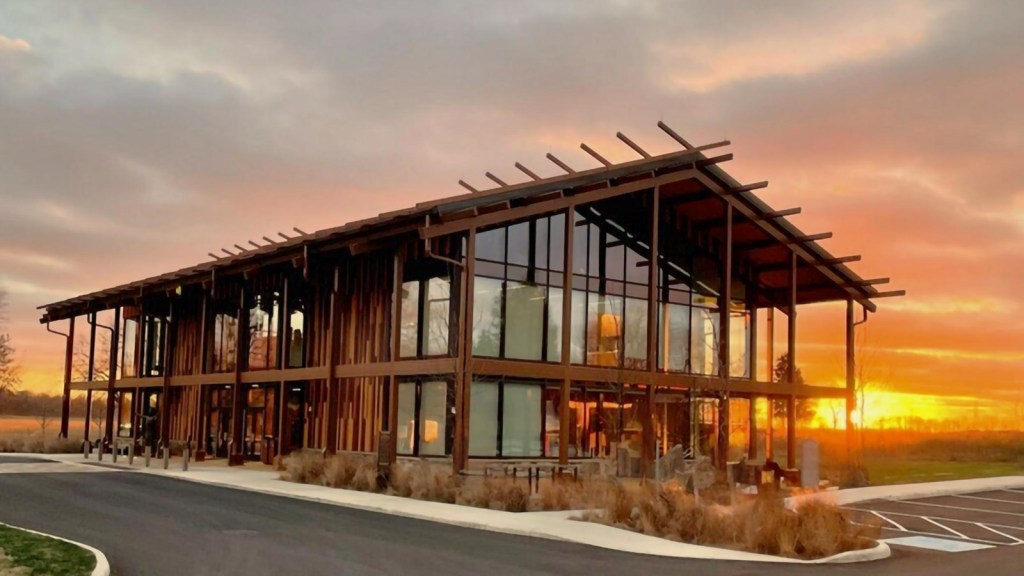
The Great Council State Park Interpretive Center is an impressive facility with museum-quality exhibits on Shawnee and other native American cultures. (Credit: Ohio Department of Natural Resources)
By Ken Drenten
Ohio’s newest state park, opened in 2024, celebrates and honors the history and culture of some of Ohio’s oldest residents.
Great Council State Park in Xenia is located near the site of the Shawnee village of Old Chillicothe, home to more than 1,000 people in the 1770s. The park takes its name from “Great Council,” referencing the important role of councils and decision-making in Shawnee governance and community life.
The highlight of the park is a stunning 12,000-square-foot interpretive center modeled after a historic Shawnee longhouse. The center features museum-quality historic displays and gallery spaces with cultural exhibits, as well as a theater, an immersive “living stream” and gift shop. The spaces not only teach about the Shawnee, but earlier Hopewell and Adena peoples who lived in this part of Ohio.
Old Chillicothe, led by Chief Blackfish, was a large Shawnee town where people farmed corn, beans, squash, melons, sunflowers, fruit trees and more, and hunted the surrounding Little Miami River Valley area for meat.
The town was well known by early white settlers. Daniel Boone was captured and brought to the town in 1778, living as part of Chief Blackfish’s family until he later escaped. Simon Kenton was also brought as a captive to the town and made to run the gauntlet multiple times. Tecumseh, the most famed Shawnee leader, would also have been familiar with the town.
The town was attacked by militia led by Gen. Benjamin Logan in 1779, resulting in Chief Blackfish’s death. Old Chillicothe was evacuated the following year and ultimately destroyed by an army led by Gen. George Rogers Clark. White settlers established residences by 1797, and the area was known as Oldtown by around 1812 to 1815.
Remnants of the Shawnee people moved from Ohio as a result of the early 1830s due to treaties and federal acts. Most settled in what are now the states of Kansas, Missouri and Texas. Subsequent removals would move them to Indian Territory, which became Oklahoma. Today, Shawnee people are located in three federally recognized tribes: Absentee-Shawnee Tribe of Indians of Oklahoma, Eastern Shawnee Tribe of Oklahoma, and Shawnee Tribe, all headquartered in Oklahoma.
The interpretive center offers guided tours, workshops and demonstrations, and family-friendly special events. The park’s interpretive center and gift shop are open 10 a.m.-5 p.m. Wednesday through Sunday, closed Monday and Tuesday. Trails and outdoor park grounds are open 6 a.m.-11 p.m.
The park also includes the Blackfish Trail, a half-mile trail featuring a restored prairie full of native plants. The adjacent Tecumseh Preserve Trail ends with a view of the Little Miami River. No pets are allowed in the preserve.
There are no camping or overnight use facilities at the park, which is located at 1587 U.S. 68 North, Xenia. Call (937) 502-0057 for information.
Ken Drenten is creator and editor of Dusty-Tires.com, a travel blog for out-of-the-ordinary places in Ohio.
Share Dusty Tires with a friend; your likes and comments are appreciated. Be sure to check out the Dusty Tires YouTube channel. And subscribe to Dusty Tires and receive a weekly email with the latest blog article. It’s free!
All rights reserved, Dusty Tires (dusty-tires.com), 2026.
Share this:


Leave a Reply