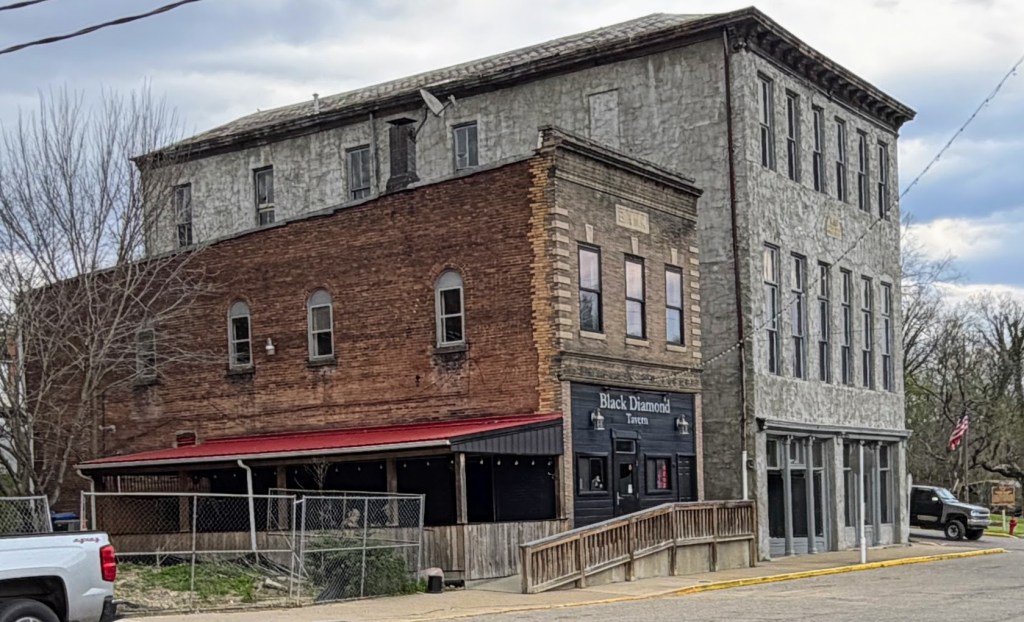
The Black Diamond Tavern in Shawnee is housed in a renovated 150-year-old building on the town’s historic Main Street. (Credit: Ken Drenten)
By Ken Drenten
Perry County is a region of rolling hills, steep valleys and curving ridgelines. It’s a place where coal, oil and clay have played a major role in the economy and if you look hard enough, you’ll find diamonds.
Driving through New Lexington and Shawnee last week I got some glimpses of those diamonds in the rough that are still developing.
New Lexington is one of the few county seats in Ohio that falls short of being a city, with a population that dips below 5,000. Yet it’s full of history and heritage, having been founded in 1817 and becoming the seat of Perry County in 1857 after some contentious rivalries with other towns in the county.
It’s also the home of a dashing hero whose pen was truly mightier than the sword, Januarius MacGahan. MacGahan, born near New Lexington in 1844, was a journalist and war correspondent in Europe. A cousin of Gen. Phil Sheridan, he learned Russian and married into Russian nobility.
For much of his career, he reported on conflicts in France, Russia and Central Asia. His articles were groundbreaking for their realism and influence, and his reports about massacres of Bulgarian civilians by Turkish soldiers caused huge public outrage.
His work contributed heavily to independence and peace for Bulgaria in the country’s war with the Ottoman Empire. He was considered a hero by the people of Bulgaria and was given the title “Liberator of Bulgaria.” He died while still a young man of typhoid fever in 1878.
If the video link above does not appear or function, please use this link — https://youtu.be/BSwnQhiCVsU
The village of Shawnee is a diamond unto itself. The town, established in 1872, became a village in 1874 and became knowns as “The Main Street of the Little Cities of Black Diamonds.”
The town was populated mainly by workers in coal mining, oil extraction and clay industries. At its peak in the early 1900s, the town had a population of nearly 4,000 people, and the village had hotels, banks, saloons and a variety of stores and shops.
The coal boom was over by early 1920s; the town began to decline, followed by the Great Depression. Most people left, and the current population is around 700. Despite the decline, many historic buildings remained, and citizens rallied to preserve what was left.
Historic buildings include Knights of Labor Opera House (1881) and the Tecumseh Theatre (1908). In the early 2000s, Shawnee was designated a Preserve America community and received Save America’s Treasures grants for historic preservation.
Nonprofit efforts — especially by Sunday Creek Associates and the Little Cities of Black Diamonds — have helped revitalize the area through festivals, walking tours, and a regional coal museum. In addition, Shawnee is an official Trail Town of the Buckeye Trail and of the Appalachian Ohio micro-region.
The Buckeye Trail organization is headquartered in Shawnee. The trail is 1,444 mile hiking route around Ohio.
Shawnee businesses now include Black Diamond Tavern, Ohio’s Winding Road Marketplace, Hannah Brothers Furniture Store, Shawnee Village Restaurant and Wohrle Carryout. Shawnee is just a few miles south of New Lexington and borders the Wayne National Forest, which offers opportunities for outdoor pursuits such as hiking, ATV riding, hunting, fishing and camping.
Ken Drenten is creator and editor of Dusty-Tires.com, a travel blog for out-of-the-ordinary places in Ohio.
Share Dusty Tires with a friend; your likes and comments are appreciated. Be sure to check out the Dusty Tires YouTube channel. Subscribe to Dusty Tires and receive a weekly email with the latest blog article. It’s free!
All rights reserved, Dusty Tires (dusty-tires.com), 2026.


Leave a Reply