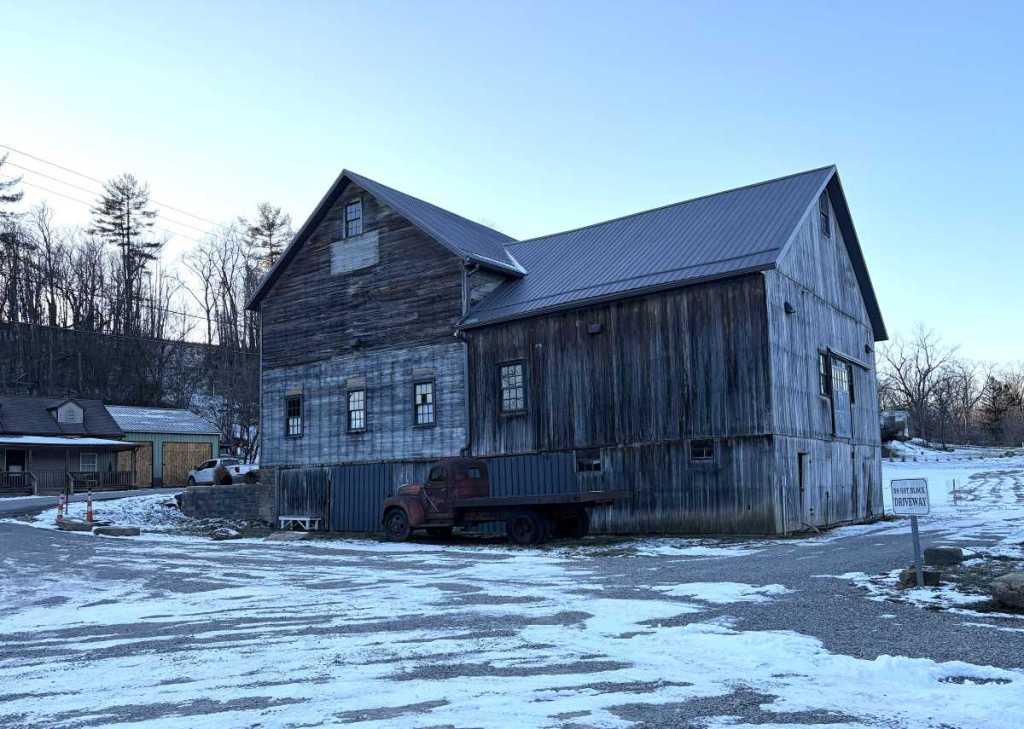
J. Weller & Sons Mill is now part of an event venue business, The Mill at Jonathan Creek in East Fultonham. (Credit: Ken Drenten)
By Ken Drenten
At the height of the era of old country mills in Ohio, there were 18 such mills in Muskingum County. Now there are only two venerable mills that remain standing in the county, both along Jonathan Creek in Newton Township.
The first mill is located in East Fultonham. It was for many years known as J. (John) Weller & Sons Mill and later operated as a community store and feed mill. Fultonham’s first mill and store was built around 1812 along Jonathan Creek by Jacob Crooks. I have not found any clear confirmation if this was the same mill.
To confuse matters somewhat, there are two Fultonhams in the vicinity — East Fultonham and Fultonham. Fultonham, originally called Uniontown, was platted in 1815.
John Wesley Weller was born in 1858 and died in 1948. Weller was well known as the operator of the mill in East Fultonham.
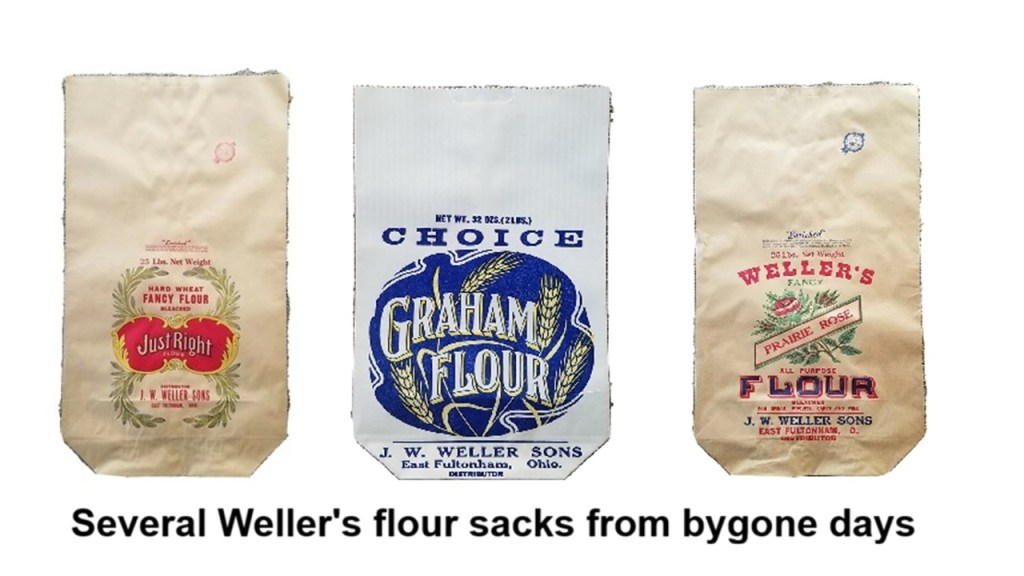
Weller Mill was originally a flour mill, producing J.W. Weller Flour, (some of their known brands were Graham Flour, Just Right Flour and Prairie Rose Flour). At some time after that (I don’t know the exact dates) it operated for many years as a feed mill and store. After that business closed at an unknown date, the mill was used for equipment storage. If anyone knows more about the early history of the Weller mill, please share.
Fultonham is the home of Weller Pottery. John Weller’s brother Samuel Franklin Weller (1847-1924) founded the famed pottery in the village in 1872. Originally, his business consisted of a small cabin and one beehive kiln, producing flowerpots, bowls, crocks and vases. By 1905, Weller Pottery was the largest pottery in the country. It mass-produced art pottery until about 1920 and produced commercial lines until the pottery closed in 1948.
The town is also the birthplace of Thomas A. Hendricks (1819-1885), who went on to become an Indiana state and national legislator, Indiana governor and vice president serving with Grover Cleveland.
Check out this video for a look at J. Weller & Sons Mill and Gladstone Mill. If the embedded video above does not work or appear in the email, please use this link — https://youtu.be/1H00gkiS9M0
Weller Mill, which was not part of the pottery business, is now the centerpiece of an event business, The Mill at Jonathan Creek, 7105 Old Town Road. Family owned and operated, the business is set on seven acres and is an all-occasion venue for weddings, parties, receptions, reunions and other events.
The Mill at Jonathan Creek has been in business since 2020, and since then has expanded and enhanced its spaces to make them more comfortable, accessible and enjoyable for guests.
For more information about The Mill at Jonathan Creek, call (740) 683-0802.
To find J. Weller & Sons Mill from Zanesville, go southwest on US 22 past the community of White Cottage. Turn right onto Old Town Road and enter the village of East Fultonham. Go less than one mile. The mill sits just past Jonathan Creek on the north side of Old Town Road at the junction with Hoover Street/CR 653.
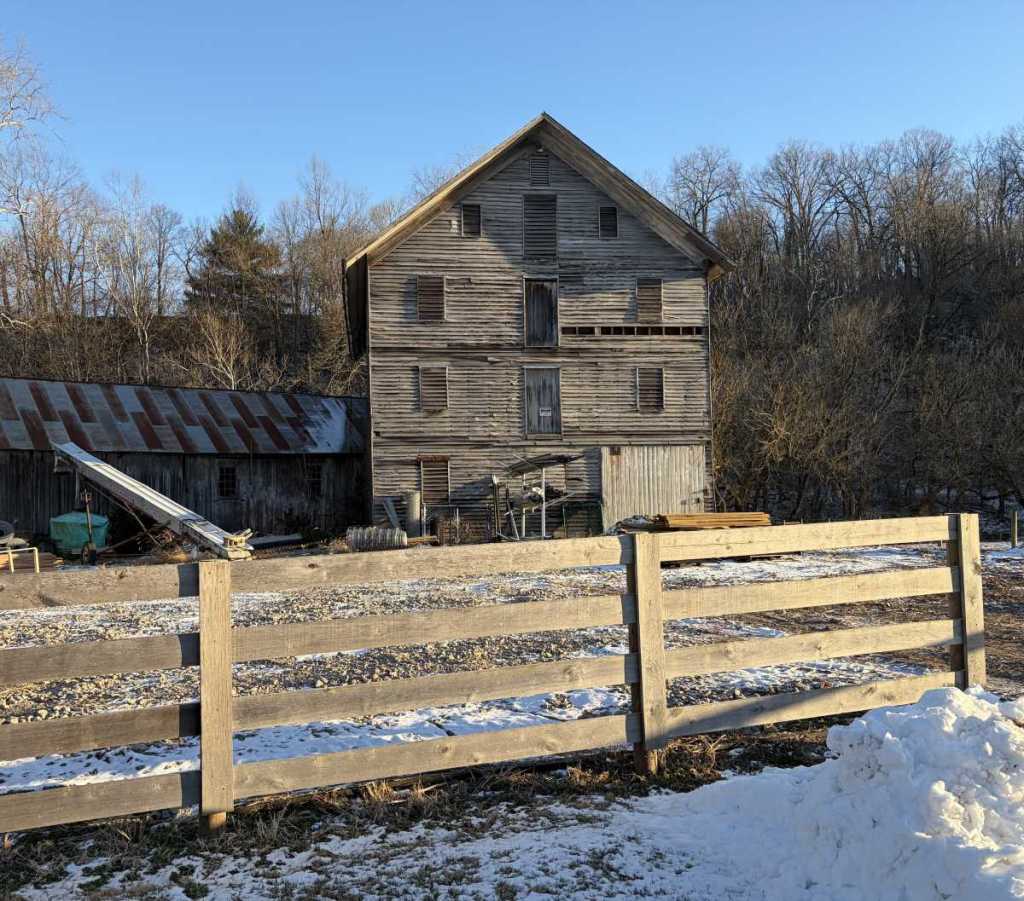
Gladstone Mill is located in White Cottage along Jonathan Creek. (Credit: Ken Drenten)
The second mill standing in Muskingum County is Gladstone Mill in the village of White Cottage, just a mile or so away from the twin Fultonhams.
Gladstone Mill was constructed in 1813. It was recorded to be owned by C. Lenhart in 1833 and a miller named Straight was operating it until 1864 when William and David Gladstone purchased the mill. The Gladstones rebuilt and expanded the mill, adding a vertical sawmill on the north side of the mill building, according to “Waterwheels and MIllstones: A History of Ohio Gristmills and Milling,” by D.W. Garber, published by The Ohio Historical Society in 1970.
The mill continued functioning as a gristmill until 1913, when the Great Flood of 1913 damaged the millrace and waterwheel beyond repair. Gladstone Mill never functioned again.
Today, Gladstone Mill is still standing along Jonathan Creek and is owned by descendants of the Gladstone family. The 3-1/2-story structure is used to store equipment and materials. It is located behind the William Thompson & Son Funeral Home.
White Cottage established a post office in 1839. The village was named after a white-painted tavern used by travelers along Zane’s Trace.
To find Gladstone Mill from Zanesville, take US 22 southwest 4 to 5 miles to the vicinity of White Cottage. Turn left (east) on Limestone Valley Road, then a little more than 1 mile, turn onto Gladstone Drive.
Ken Drenten is creator and editor of Dusty-Tires.com, a travel blog for out-of-the-ordinary places in Ohio.
Subscribe to Dusty Tires and receive a weekly email with the latest blog article. It’s free!
All rights reserved, Dusty Tires (dusty-tires.com), 2026.

 Dusty Tires
Leave a reply to Kathy Wolfe Cancel reply