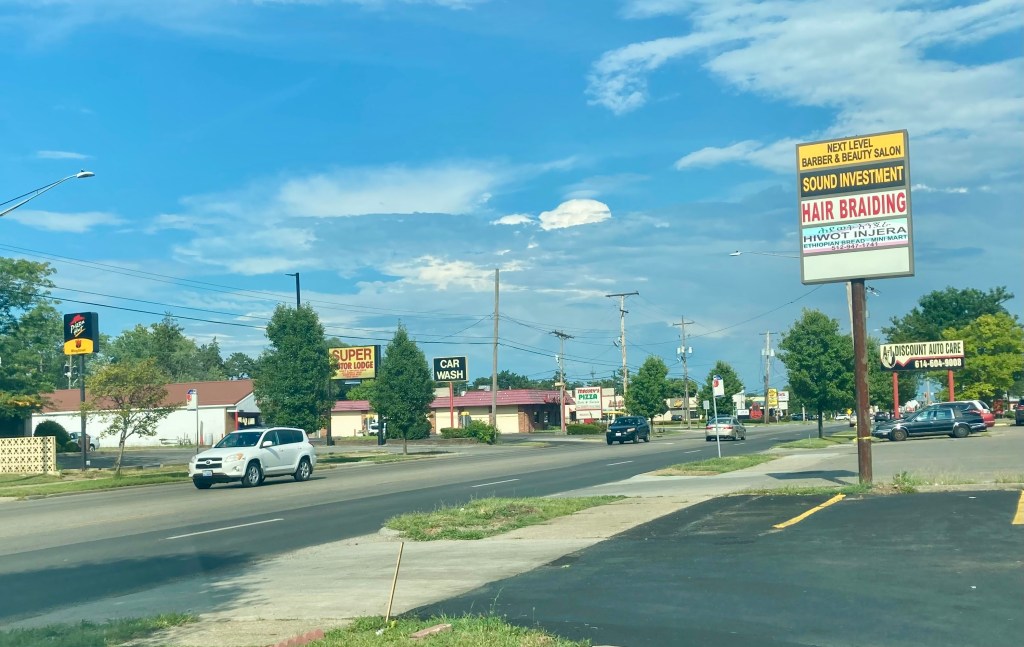
U.S. 40/National Road in Whitehall, or East Main Street, began development in the 1950s, but only a handful those era’s businesses are still operating today. The same goes for rest of this heavily developed, high-traffic U.S. 40 in east Columbus, Reynoldsburg and Bexley. (Credit: Ken Drenten)
By Ken Drenten
If there is one section of the National Road and U.S. 40 that I have known well, it’s the part that drives straight into east Columbus and its suburbs, where I grew up and went to school.
I grew up in the 1960s and ’70s near East Livingston Avenue and Shady Lane Road, only about a mile south of U.S. 40. I attended elementary, junior high and high school in a community that was bounded by U.S. 40 on the north. In my late teens and early 20s, I worked at a restaurant that was on East Main Street, as U.S. 40 is called in east Columbus.
So to call this my “old stompin’ grounds” is pretty accurate. The challenge with this segment of Dusty Tires on the Road is to try to view the National Road with new eyes, instead of those that have taken it for granted all these years.
It’s such a high-traffic area that it’s easy to miss the little changes that have happened over the years.
There are many motels on this stretch — the Brookside, Capital, Homestead, Colonial, Holiday, Casa Villa motels and Super and Columbus motor lodges — that date back to the 1940s through the ’60s. Many more motels and other businesses used to be part of the same landscape but are now gone.
I can remember Emil’s Steer Inn, the Big Bear grocery store (where you could get S&H Green Stamps), the East Main Drive-In Theatre, Del Matto’s Restaurant, Connell Hardware, Sun TV and Appliance, Swallens, Zayres, Whitehall’s Department Store, Lawson’s convenience store, Hammonds Electronics (“Hammonds Knows Car Stereo”), the Pour House and many other businesses that came and went in Whitehall and Reynoldsburg along U.S. 40.
Many things haven’t changed — the intersection of E. Main Street and S. Hamilton Road in Whitehall is still one of the busiest intersections in central Ohio. In fact, the heavy traffic on this stretch of road is definitely something that has not changed over the years.
Several mid-20th century eateries like pizzerias Massey’s (early 1950s) and Rubino’s (1954), The Top Steakhouse (1955) and Johnson’s Real Ice Cream (1950) continue to thrive, as does the 1937 movie palace The Drexel Theatre.
The Grill & Skillet diner, which had been open since 1945, closed in spring 2025. I noticed on a sign that the Wheelhorse motorcycle sales and service business in Reynoldsburg is closing after 48 years in business.
Note: If the embedded video above does not appear in the email, please use this link — https://youtu.be/1U1Df_6ki2A
Reynoldsburg is called “The Birthplace of the Tomato” in recognition of Alexander Livingston who cultivated the first commercially viable tomato in the 1870s. Ketchup lovers like me rejoice over this. The town was incorporated in 1839, taking its name from merchant John Reynolds.
Whitehall was officially incorporated in 1947, but its roots as a farming community and tavern stop go back prior to the National Road coming through in the early 1830s. Both Whitehall and Reynoldsburg can claim origins back to the late 18th century as part of lands granted to Canadian refugees who fought against Great Britain in the Revolutionary War.
Capital University in Bexley was founded in 1830. The stately community of Bexley, home of the Governor’s Mansion, itself did not organize as a city until 1908.
Ken Drenten is creator and editor of Dusty-Tires.com, a travel blog for out-of-the-ordinary places in Ohio.
Subscribe to Dusty Tires and receive a weekly email with the latest blog article. It’s free!
All rights reserved, Dusty Tires (dusty-tires.com), 2025.


Leave a comment