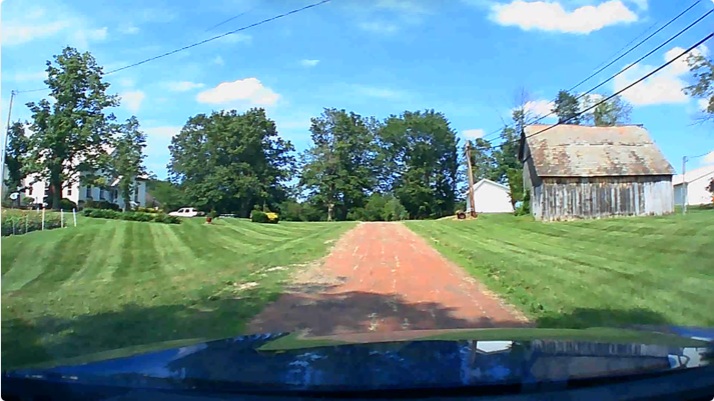
This section of the National Road is called Peacock Road. It was paved with brick around 1918-19. (Credit: Ken Drenten)
By Ken Drenten
The second installment in the series of Dusty Tires on the Road that features the National Road did not come easily.
Wasn’t it Ringo Starr who sang about paying your dues and things not coming easy? I think that’s definitely true. That would have made a great song for this video, but since it’s licensed, I can’t use it.
My goal on the Saturday afternoon I set out was to record my drive from just east of Cambridge all the way to Bridgeport at the Ohio River. This was the first time in a long time (if ever) I have driven most of the roads along this route.
U.S. 40 and the National Road in this part of the state are very broken up. When I-70 was built in the 1960s, there were sections of both roads that were bypassed, destroyed and buried by construction.
The main reason for this was that the new high-speed road needed to remove as many twists, turns and hills as possible. The original National Road built in the 1820s and 1830s generally followed the contour of the land and was built for Conestoga wagons and horses, rather than automobiles and semi-trucks.
Because of that, there is no single, unbroken road designated as U.S. 40 or the National Road that will take you from the Ohio River to Cambridge. It’s split up into county roads, the I-70 freeway, segments of two-lane highway, and even no road at all.
Knowing all this and armed with some hand-written notes to keep myself on track, I set out. I immediately made a wrong turn, turned around and started over again. This pattern repeated itself several times during the trip, although I edited out most of the wrong turns.
I also stopped for breaks at several points. Unfortunately, at one stop, I turned the camera back on but forgot to hit the “record” button (I only learned this when I got home). So what I ended up recording was less than half of the trip that I actually made.
But I did have about a half-hour’s worth of video that covered a section from just east of Cambridge to the Quaker City I-70 exit just east of Middlebourne.
With this video, I tried recording a brief message at the start of the trip. I also recorded my ongoing commentary as we went along, using the built-in microphone in the camera. It’s not easy to safely drive, think about where you need to go on unfamiliar roads and talk about it all at once.
The audio results are mixed; along with my voice, the mic picked up lots of engine noise, road noise and static every time the car hit a bump. Next time, I plan to keep the microphone turned off during the trip and add recorded narrative later on in the editing process.
I also experimented with combining the recorded in-car audio with music and varying the sound levels of each. It took about five or six tries of posting the results to YouTube to produce something that I felt comfortable releasing publicly.
So with all that said, this was probably the most difficult video I’ve done so far. The result was a combination of unfamiliar roads, trying to do new things and the resulting learning curve.
One village that I passed through on this trip was Old Washington, the site of a Civil War skirmish between Gen. John H. Morgan’s Raiders from the South and a combined force of about 1,000 Union Army mounted infantry and Ohio militia. It was the only military action that occurred on the National Road during the Civil War.
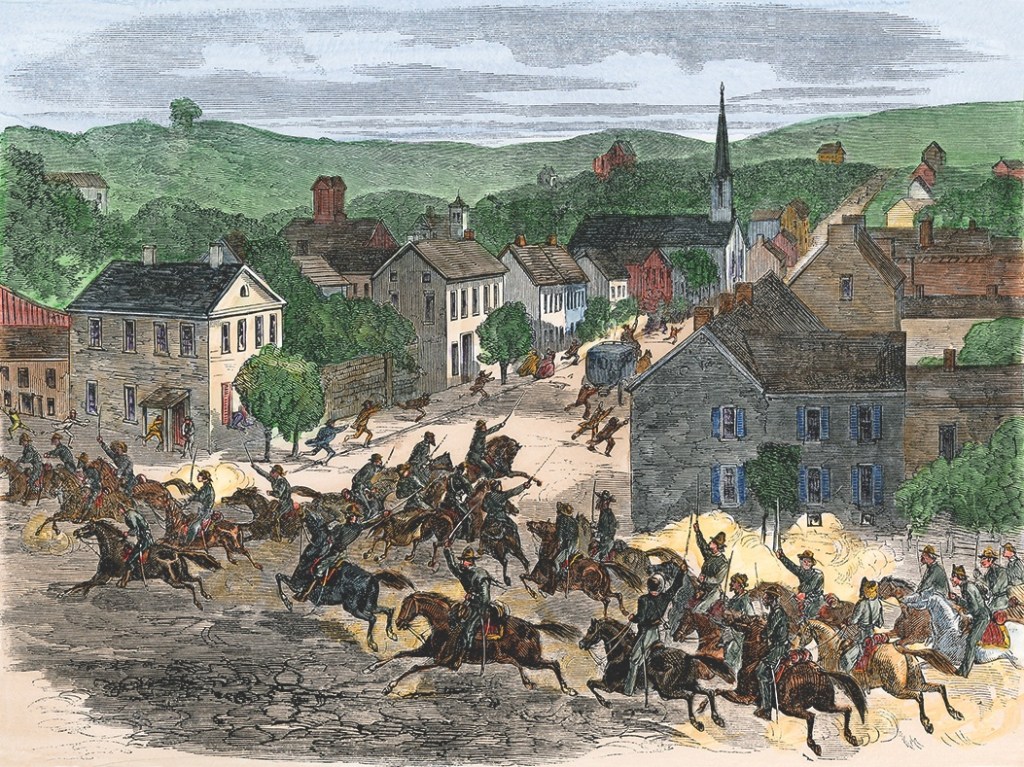
This illustration appeared in news reports about the events in Old Washington in July 1863.
A column of 670 exhausted Confederate cavalrymen led by Morgan entered the town the morning of July 24, 1863, to rest and refit. Most of the men camped in the town square, while the officers stayed at the American House, a two-story hotel at the southeast corner of the intersection of present-day SR 285 (Old National Road) and Morgan’s Way. The troops posted guards, were fed by women in the village, and rested.
When Union troops arrived a few hours later, Confederate sentries fired a warning shot and the raiders quickly began mounting up to elude capture. Both sides fired at the other in a chaotic scene, with civilians scrambling for safety.
When it was over and the rebels had escaped, three raiders lay dead and several others wounded. A number of Confederates were taken prisoner. (Information summarized from the book “The Longest Raid of the Civil War,” by Lester V. Horwitz.)
At any rate, I hope this video is interesting and enjoyable, and if you do like it, please let me know and subscribe to my new YouTube channel, Dusty Tires.
Ken Drenten is creator and editor of Dusty-Tires.com, a travel blog for out-of-the-ordinary places in Ohio.
Subscribe to Dusty Tires and receive a weekly email with the latest blog article. It’s free!
All rights reserved, Dusty Tires (dusty-tires.com), 2025.


 Dusty Tires
Leave a reply to Terry Cancel reply