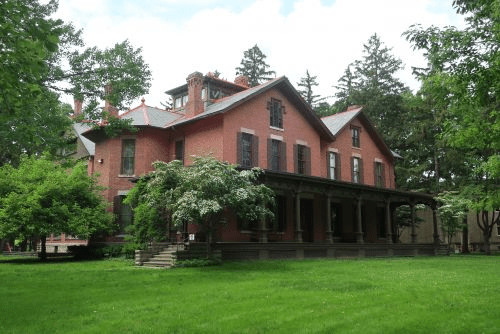
Spiegel Grove, the home of Rutherford B. Hayes in Fremont, Ohio. (Credit: Rutherford B. Hayes Presidential Library & Museums)
By Ken Drenten
Ohio has provided eight U.S. presidents to the nation. Each of these presidents has left a legacy of historic homes, libraries, museums, final resting places and other historic sites in the state to learn more about their lives and terms in office.
National First Ladies’ Library
Wife of an Ohio Congressman, Mary Regula, was incredibly passionate about speaking about and researching the First Ladies of the United States. Regula helped allocate funds and research efforts to assemble a comprehensive bibliography on American First Ladies. From these efforts and planning, a library, research center and National Historic Site was founded at the Ida Saxton McKinley Historic Home in 2000. You can find the National First Ladies’ Library and the Education and Research Center in Canton.
Ninth U.S. President – William Henry Harrison, 1841
William H. Harrison (Feb. 9, 1773-April 4, 1841) served the shortest presidency in U.S. history, from March 4 to April 4, 1841. He was also the first president to die in office, and the last president to have been born as a subject of Great Britain in the Thirteen Colonies, born in Virginia. He was the grandfather of Benjamin Harrison, the 23rd U.S. president. Harrison served as Major General of the U.S. Army in the War of 1812, participating in the battles of Fallen Timbers and Tippecanoe. From 1798 until his election as president in 1840, Harrison served as secretary of the Northwest Territory and its delegate to the U.S. House of Representatives; governor of the Indiana Territory; U.S. House of Representatives member for Ohio, and U.S. Senator for Ohio. Just a few weeks after his inauguration on March 4, 1841, Harrison fell ill and died. You can visit his resting place at the William Henry Harrison Tomb in the Congress Green Cemetery in North Bend, Ohio.
18th U.S. President – Ulysses S. Grant, 1869-1877
Ulysses Simpson Grant (April 27, 1822-July 23, 1885) rose from an unremarkable civilian life as an ex-soldier to becoming Commanding General of all Union armies during the Civil War, and eventually accepting Confederate Gen. Robert E. Lee’s surrender at Appomatox, Va. His wartime fame translated into being elected president as a Republican in 1868. His terms were instrumental in putting the final end to slavery and implementing Reconstruction. But his two terms were also marked by corruption which contributed to economic malaise. Grant’s childhood home, tannery, and schoolhouse are located in Georgetown, Ohio.
19th U.S. President – Rutherford B. Hayes, 1877-1881
Before being elected President in 1876, Rutherford B. Hayes (Oct. 4, 1822-Jan. 17, 1893) was a brevet Major General in the Civil War, a lawyer, vocal abolitionist, member of Congress and Governor of Ohio. Much of his life’s work was dedicated to repairing trust in the office of the President and strengthening the country after the assassination of Abraham Lincoln. He was also devoted to educational and social reform. His home and resting place is in Fremont, Ohio, at the Rutherford B. Hayes Presidential Library & Museum.
20th U.S. President – James A. Garfield, 1881
Born in Moreland, James A. Garfield (Nov. 19, 1831-Sept. 19, 1881) served in the Ohio State Senate, the Union Army as Major General and was elected to Congress to represent Ohio’s 19th District. Garfield’s first term as president was cut short after only 200 days when he was shot in an attempted assassination on July 2, 1881, and died from unsanitary treatment of his wounds Sept. 19. You can visit his tomb in Cleveland at the famous Lake View Cemetery, his home and dedicated park in Mentor, and his birthplace at Moreland Hills.
23rd U.S. President – Benjamin Harrison, 1889-1893
Benjamin Harrison (Aug. 20, 1833-March 13, 1901), a North Bend native, came from a long line of influential Americans. His great grandfather and namesake was a signer of the Declaration of Independence, and his grandfather, William Henry Harrison, was the ninth president of the United States. A graduate of Miami University, a Union Army veteran and a Republican, Harrison supported civil service reform and increased the number of jobs under the Civil Service Act. His birthplace is in North Bend, Ohio, where you can see where he was born and raised.
25th U.S. President – William McKinley, 1897-1901
William McKinley (Jan. 9, 1843-Sept. 14, 1901) was the last President elected to have served in the American Civil War, ending his service as a brevet Major. Native to Ohio, he lived and worked as a lawyer most of his life. McKinley then became a congressman and entered gubernatorial office in Ohio which secured his nomination as the Republican presidential candidate in 1896. Known for stimulating rapid economic growth, McKinley also led America through the Spanish-American war which resulted in the U.S. annexation of Puerto Rico and Guam, as well as control of Cuba and Hawaii. He was shot in Buffalo, N.Y., on Sept. 6, 1901, and died eight days later. You can find the McKinley Memorial in Niles, as well as the McKinley Presidential Library and Museum in Canton.
27th U.S. President – William H. Taft, 1909-1913
William H. Taft (Sept. 15, 1857-March 8, 1930) is the only person in history to have held both seats of Chief Justice of the United States and the Presidency. Taft, a Republican, spent most of his life practicing or learning about law. Born in Cincinnati, he later returned to conduct law classes at the Cincinnati Law School and also wrote for the Cincinnati Commercial Newspaper. Prior to his presidency, he served as governor of the Philippines and U.S. Secretary of War. He served as Chief Justice of the U.S. Supreme Court from 1921 to 1930. You can find his birthplace and childhood home at the William Howard Taft National Historic Site in Cincinnati.
29th U.S. President – Warren G. Harding, 1921-1923
Warren G. Harding (Nov. 2, 1865-Aug. 2, 1923) was the first person to become President while also being a sitting U.S. Senator. Before his administration, Harding was also Lieutenant Governor of Ohio and served in the Ohio State Senate. Harding was best known in Ohio for managing several newspapers in his hometown and college, most notably the Marion Star. With the town doubling their population in the 1800’s, Harding’s newspaper became an influential small-town resource. To date, he is the only president with journalism experience. Harding died of a heart attack while in office. His presidency is best known now for the infamous Teapot Dome scandal. You can find his home and tomb in Marion, as well as the Warren G. Harding Presidential Library & Museum.
Ken Drenten is creator and editor of Dusty-Tires.com, a travel blog for out-of-the-ordinary places in Ohio.
Subscribe to Dusty Tires and receive a weekly email with the latest blog article. It’s free and ad-free!
All rights reserved, Dusty Tires (dusty-tires.com), 2024.


 Dusty Tires
Leave a reply to kdrenten Cancel reply