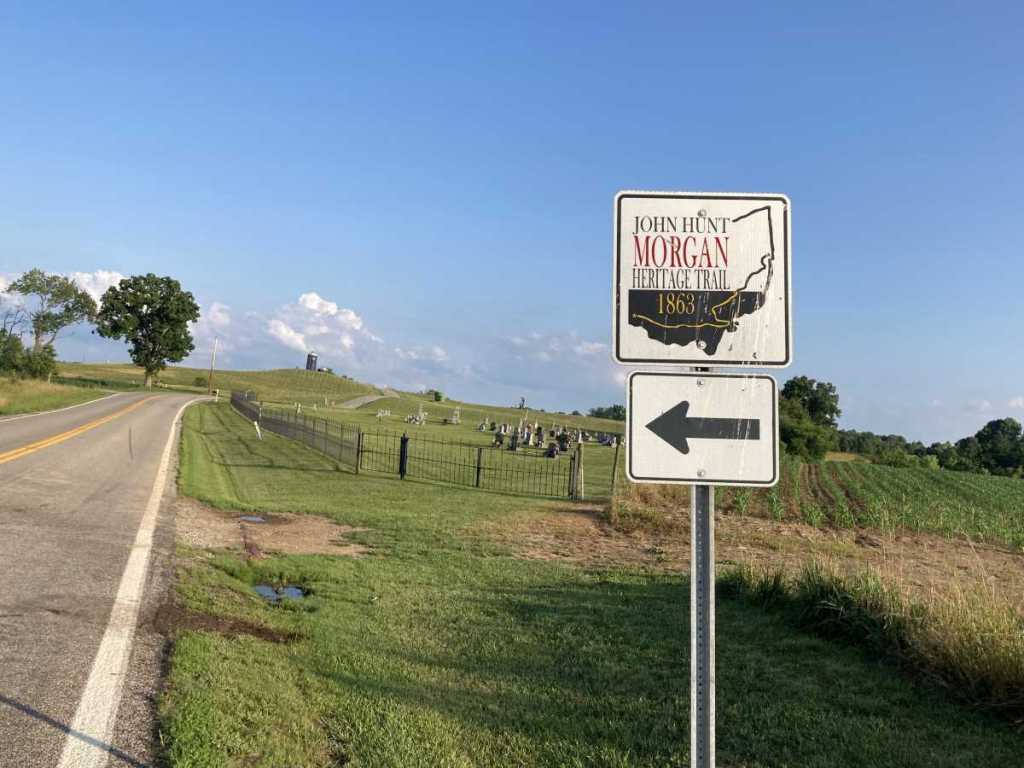
This John Hunt Morgan Heritage Trail sign is located along SR 669 at the site of the Weaver Farm in Morgan County, where the raiders spent the night. (Credit: Ken Drenten)
By Ken Drenten
Thursday, July 13, 2023, marks 160 years since Confederate mounted troops under Brig. Gen. John Hunt Morgan entered Ohio as part of an action known as Morgan’s Raid, or The Great Raid.
Morgan and his men crossed the Ohio River into southern Indiana on July 8, 1863. He had exceeded his orders, which had been to limit the raid to Kentucky in order to divert Union troops from positions in Tennessee.
The raid resulted in the only significant Civil War battle fought on Ohio soil, the Battle of Buffington Island, on July 19, 1863, near Portland, Ohio. Morgan’s men also fought skirmishes with Ohio militia and pursuing Union troops near Camp Dennison on the outskirts of Cincinnati, as well as in Jackson County, Cheshire, Eagleport, Old Washington, Wintersville and Salineville. What remained of the force finally surrendered near the hamlet of West Point, near Lisbon, Ohio, on July 26, 1863.
Among the Union officers involved in the running battles with Morgan’s Raiders were two future U.S. presidents, Col. Rutherford B. Hayes and Lt. William McKinley Jr.
Today, the John Hunt Morgan Heritage Trail follows the route of this daring (or infamous, depending on one’s perspective) raid that for a few weeks caused widespread panic and outrage throughout the state.
The driving tour begins at Harrison, winds through southern and southeastern Ohio and ends 557 miles later near West Point in eastern Ohio. The trail features 56 interpretive wayside exhibits and more than 600 directional signs.
One wayside marker in Morgan County (named for Morgan’s ancestor, Brig. Gen. Daniel Morgan, who served in the Revolutionary War) describes how Morgan and about 600 of his men stayed overnight at the Weaver Farm. Morgan slept on a straw tick on the floor of the family’s log cabin, while his men slept in the farm’s orchard.
The information on the marker states that Mrs. Weaver stayed up all night fixing the men a breakfast of griddlecakes and biscuits. Mr. Weaver was asked to guide the soldiers to Eagleport to cross the Muskingum River. When they approached the river crossing, he was released unharmed.
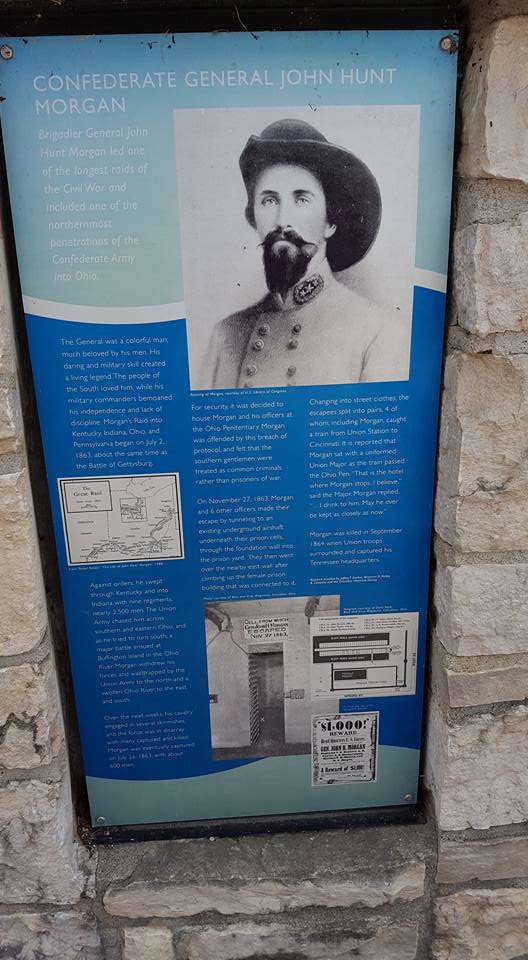
This interpretive sign in North Bank Park on E. Spring Street in downtown Columbus describes the daring escape of John Hunt Morgan from the Ohio Penitentiary. (Credit: Ken Drenten)
After their capture, Morgan and other officers were imprisoned in the Ohio Penitentiary in Columbus, while enlisted men were stockaded at Camp Chase in Columbus.
Morgan and a group of his officers escaped from the Ohio Penitentiary on Nov. 27, 1863. An interpretive sign in North Bank Park on E. Spring Street in downtown Columbus describes the event. Morgan did not survive the war. After participating in several other raids, Morgan was shot and killed by Union cavalry in Greeneville, Tenn., in September 1864.
(Source: Ohio History Central)
Subscribe to Dusty Tires and receive a weekly email with the latest blog article. It’s free and ad-free!
Ken Drenten is creator and manager of Dusty-Tires.com, a travel blog for out-of-the-ordinary places in Ohio.
All rights reserved, Dusty Tires (dusty-tires.com), 2023.


 Dusty Tires
Leave a reply to kdrenten Cancel reply