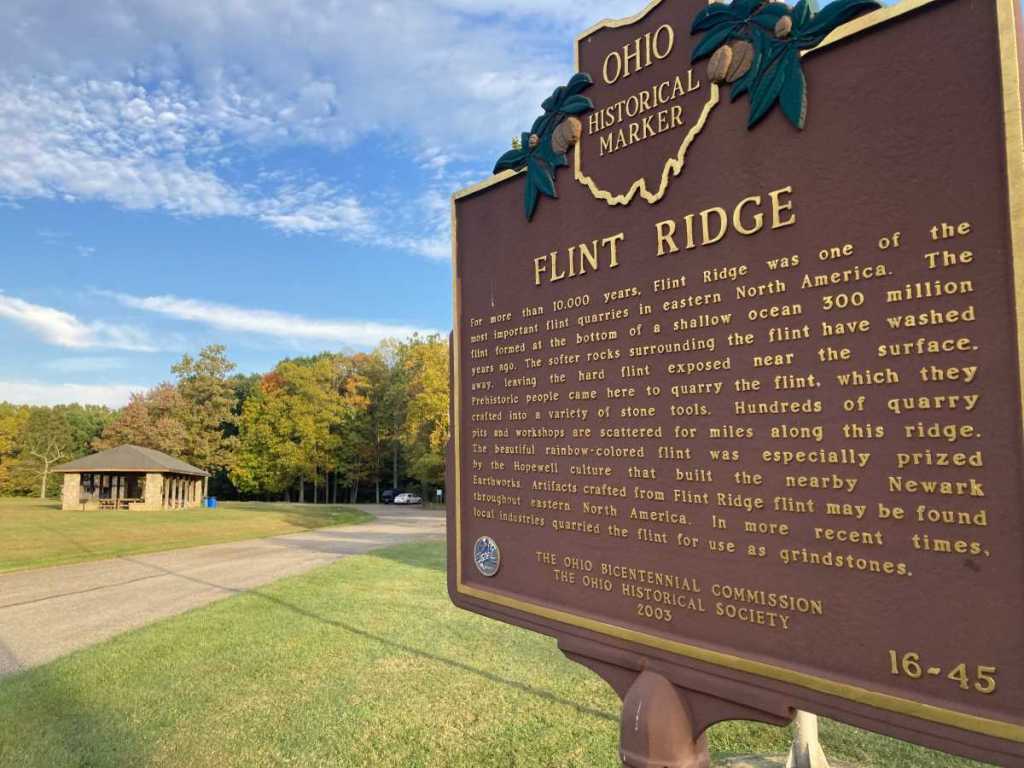
Flint Ridge Ancient Quarries and Nature Preserve in Licking County was one of the most important sites to ancient people in eastern North America for the flint reserves found here.
Ohio has a rich collection of historic sites that pertain to Native Americans. A number of Ohio’s Native American heritage sites recently gained world-class status. The UNESCO World Heritage Committee recently made a consensus decision to include the Hopewell Ceremonial Earthworks in Ohio as a World Heritage Site.
The eight ancient earthwork sites are in southern and east-central Ohio; five of the earthwork sites are managed by the National Park Service and three are managed by the Ohio History Connection.
The properties comprising the Hopewell Ceremonial Earthworks are:
- Hopewell Culture National Historical Park in Chillicothe, including the Mound City Group, Hopewell Mound Group, Seip Earthworks, High Bank Earthworks and Hopeton Earthworks.
- The Ohio History Connection’s Octagon Earthworks and Great Circle Earthworks in Newark and Fort Ancient Earthworks in Oregonia.
Here are Ohio’s major sites related to Native American history.
Flint Ridge Ancient Quarries and Nature Preserve – Hike trails through the 533-acre preserve and see ancient pits left by American Indians who came from the surrounding area to quarry flint. The unique rainbow-colored flint was used as an item of trade, tools and weapons. Within the museum, learn about Ohio’s official gemstone and the shaping of flint into tools, known as knapping. A picnic area with tables, grills, drinking water and restrooms is available. 15300 Flint Ridge Road, Glenford (740) 344-0498.
Fort Ancient Earthworks and Nature Preserve (World Heritage Site) – Fort Ancient is North America’s largest ancient hilltop enclosure, built 2,000 years ago. A National Historic Landmark, the site is thought to have served as a social and ceremonial gathering place. Site includes on-site museum and gift shop, recreated American Indian garden and three miles of hiking trails with scenic overlooks. 6123 SR 350, Oregonia (513) 923-4421/(800) 283-8904.
Fort Hill – Fort Hill is one of the best-preserved examples of an ancient hilltop enclosure. Fort Hill was built by American Indians of the Hopewell Culture, who lived in Ohio about 2,000 years ago. Despite the name, Fort Hill was not an actual fort used for warfare, but more likely a ceremonial gathering place. Fort Hill is also a nature preserve, and the 1,300 acres are home to one of southern Ohio’s largest mature forests, with many towering old trees. 13614 Fort Hill Road, Hillsboro (800) 283-8905.
Indian Mound Reserve – City park that includes Williamson Mound, waterfall, rock formations, hiking trails, picnicking. 2750 US 42 E, Cedarville.
Inscription Rock Petroglyphs – Native Americans carved symbols into this rock on the south shore of Kelleys Island.
Hopewell Culture National Historic Park (World Heritage Site) – Visitor Center with museum, gift shop, restrooms and auditorium is located at Mound City Group, 16062 SR 104, Chillicothe. Hopewell Culture National Historic Park consists of five sites:
- Hopeton Earthworks: Circular and square earthworks and parallel walls.
- Hopewell Mound Group: Remants of walls enclose nearly 111 acres with ceremonial features residing within the enclosure.
- Mound City Group: Mound City Group’s walls enclose at least two dozen mounds in an area larger than 10 football fields.
- Seip Earthworks: Remnant mounds and remnant and reconstructed earthworks.
- High Banks Earthworks: Multiple earthen features spread over nearly 200 acres on a terrace above the Scioto River (not yet open to public).
Leo Petroglyphs & Nature Preserve – Leo Petroglyph & Nature Preserve is a legacy of the American Indian peoples of ancient Ohio. Protected beneath the roof of a shelter house, a large flat sandstone slab preserves the traces of some of the most remarkable rock art in Ohio. The panel of petroglyphs includes between 37 figurative drawings of humans, birds, animal and human footprints, a fish, a snake and other figures carved into the rock outcropping on the gently sloping hillside above a steep gorge. The art is likely the work of the Fort Ancient culture. 400 Park Road, Ray (800) 860-0144.
Logan Elm – Logan Elm features a historic monument with Chief Logan’s speech and numerous other plaques honoring American Indians and early Ohio settlers from the 18th and 19th centuries. Established in 1912, this state memorial is said to be the place where Chief Logan of the Cayuga tribe delivered an eloquent speech on relations between American Indians and early Ohio settlers in 1774. While the massive original elm tree died in 1964, a plaque marks its former location and a new elm tree was planted in 2012. 4500 SR 361, Circleville (888)770-7425.
Marietta Earthworks – Ceremonial center that includes remants of a large square enclosure surrounding four flat-topped pyramidal mounds, another smaller square, and a circular enclosure with a large burial mound at its center. Conus Mound is located in Marietta Cemetery, Fifth and Scammel streets, Marietta.
Miamisburg Mound – Miamisburg Mound is one of the two largest conical mounds in eastern North America. Listed on the National Register of Historic Places, the mound is 65 feet tall and 800 feet in circumference and contains 54,000 cubic yards of earth. The mound is visible from several miles away because it stands atop a 100-foot high ridge above the Great Miami River. Steps have been built to the top observation platform, where you can enjoy a wonderful view of the area. 900 Mound Road, Miamisburg (866) 580-6508.
Newark Earthworks (World Heritage Site) – The Newark Earthworks are the largest set of geometric earthen enclosures in the world. Already a National Historic Landmark, in 2006, the State of Ohio designated the Newark Earthworks as “the official prehistoric monument of the state.” Interpretive signage around the park will help to explain the significance of the site and why American Indians regard the Newark Earthworks as a sacred site. The parking lots are a moderate distance from earthworks and museum. A paved path with some steps provides access to the museum but there is no direct walkway to the center of the Great Circle. 455 Hebron Road, Heath (740) 344-0498.
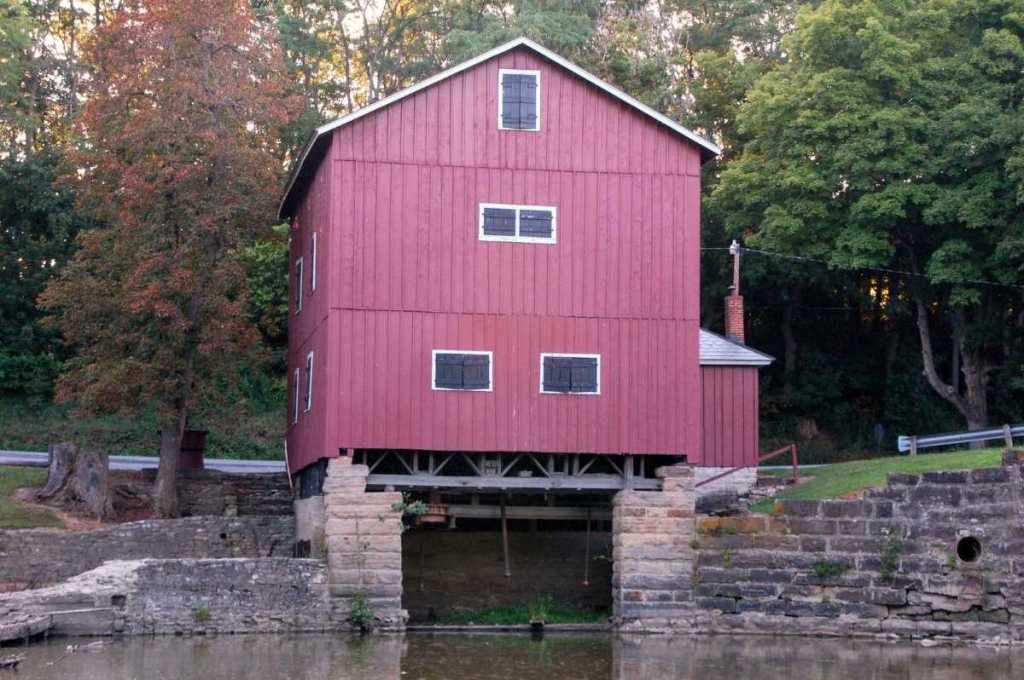
Indian Mill in Wyandot County was originally built in 1820 for the benefit of Native Americans living in Ohio.
Portsmouth Earthworks/Mound Park – Horseshoe-shaped mound in Mound Park is the only remaining remnant of earthworks that were built near the confluence of the Scioto and Ohio rivers. Mound Park, 1523 Grandview Ave., Portsmouth.
Serpent Mound – Serpent Mound could be fairly called the world’s most spectacular effigy mound. The unique mound is an internationally known National Historic Landmark built by the ancient American Indian cultures of Ohio. It is an effigy mound (a mound in the shape of an animal) representing a snake with a curled tail. Nearby are three burial mounds, two created by the Adena culture (800 B.C.–A.D. 100), and one by the Fort Ancient culture (A.D. 1000–1650). 3850 SR 73, Peebles (800) 752-2757.
Shrum Mound – One of the last ancient cone-shaped burial mounds remaining in Columbus, located in one-acre Campbell Park. Shrum Mound is a 20-foot-high and 100-foot-diameter mound built about 2,000 years ago by people of the ancient Adena culture (800 B.C.–A.D. 100). The mound is named for the donors, the Shrum family. The park is named for James E. Campbell, governor of Ohio from 1890 to 1892. 3141 McKinley Ave., Columbus (800) 840-6127.
Story Mound – Large, rounded earthen mound located on slightly less than an acre of ground. Delano Avenue, Chillicothe (800) 319-7248.
Sunwatch Indian Village Archaelogical Park – Sunwatch combines reconstructed Fort Ancient structures in their original 13th century locations, with an interpretive center that exhibits many artifacts that have been recovered from the site. The village reconstruction includes five lath and daub structures with grass thatch roofs, portions of a stockade, and a native garden and prairie with plants typical of the period. 2301 West River Road, Dayton (937) 268-8199.
Wyandot Indian Mill – Indian Mill was built in 1820 to reward the Wyandot tribes who supported the U.S. in the War of 1812. The mill was rebuilt in 1861 and became an educational milling museum in 1968. It continues to be operated by the state and the Wyandot County Historical Society. Indian Mill Park, 7417 County Road 47, Upper Sandusky (419) 294-4022.
All rights reserved, copyright Dusty Tires (dusty-tires.com), 2023.
 Dusty Tires