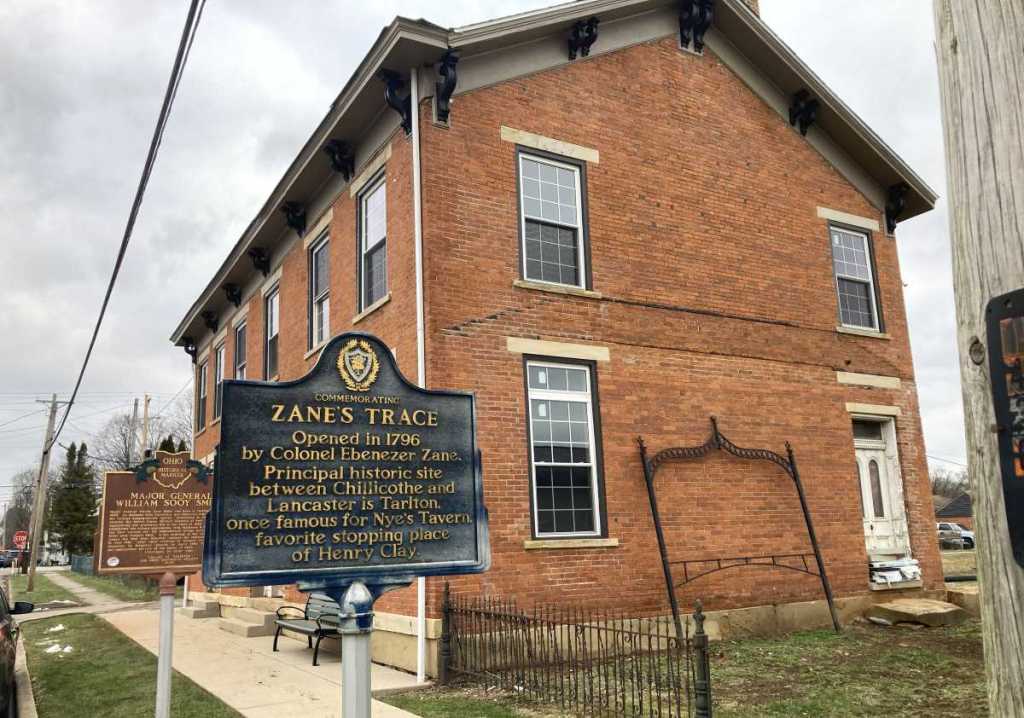
Nye’s Tavern in Tarlton was a popular stopover along Zane’s Trace since the town was halfway between Lancaster and Chillicothe. (Credit: Ken Drenten)
By Ken Drenten
This week we’re picking up where we left off on Zane’s Trace. We’ll drive from Lancaster to Chillicothe on US 22 and SR 159, in general following the trail of the historic Zane’s Trace.
For more history about Zane’s Trace, see “Tracking Zane’s Trace Part 1.”
The first historic place along the route is Tarlton, a village of about 250 that straddles Fairfield and Pickaway counties. Originally called Newellstown, the town was laid out in 1801 along Zane’s Trace, which was first opened through the area in 1796.
Tarlton is located about halfway between Lancaster and Chillicothe and was the site of Nye’s Tavern, a frequent stopping place for travelers. The tavern was a favorite spot of U.S. Congressman Henry Clay.
A current-day tavern, bar and grill is the Tarlton Town Tavern, located at 220 W. Main St. in what appears to be another historic building, though I couldn’t find much about it. Located across the street from the historic Nye Tavern is Crosstown Creamery & Diner, 90 Main St., which serves Johnson’s Real Ice Cream and diner-style breakfast, lunch and dinner menu items.
Tarlton native William Sooy Smith (1830-1916) was a notable civil engineer and U.S. Army general who served in the Civil War. Smith graduated from West Point in 1854, established an engineering company in 1857, and was involved in the first surveys for a bridge between the United States and Canada across the Niagara River near Niagara Falls.
In 1861 at the outbreak of the Civil War, Smith joined the U.S. Army and was commissioned as colonel. He was appointed brigadier general in 1862. Smith participated in the Vicksburg and Meridian campaigns in 1863 and 1864 and was a cavalry leader under Generals Grant and Sherman.
After leaving the army Smith returned to civil engineering. In 1867, he sank the first pneumatic caisson of the Waugoshanee lighthouse in the Straits of Mackinaw, Michigan. From 1878 to 1879, Smith worked on the Glasgow Railroad Bridge crossing the Missouri River, the first all-steel bridge.
Next on the route is the village of Kingston, population of about 1,300, located just inside Ross County. It was platted in 1816 and incorporated in 1834. Today, the quiet but thriving village with its Main Street along SR 159 has several pizza places and restaurants, a gourmet food store, gift shops, bank, several gas stations, fire station, a park, general store and ice cream shop.
A few miles west of Kingston is Kinnikinnick Creek and the village of Kinnikinnick, an unincorporated village at the crossroads of SR 159 and SR 180. The creek was named for the Native American tobacco product kinnikinnick, a mixture of crushed and mixed bark, leaves, herbs and medicinal plants usually smoked for ceremonial purposes.
If the video above does not appear in the email version of this article, please use this link — https://youtu.be/GEZEX-TAIOs
Chillicothe, founded in 1803, is one of Ohio’s most historic cities. First off, it was Ohio’s first and third state capital. The city is the home of Ohio’s only World Heritage Site, the Hopewell Culture National Historical Park, with ancient earthworks and mounds dating back over 2,000 years.
Adena Mansion & Gardens, built 1806-1807, was the home of Thomas Worthington, United States Senator and Governor of Ohio. The restored estate of Ohio’s sixth governor allows visitors to explore 19th-century life. The city’s population is just over 22,000.
The town’s name comes from the Shawnee “Chala-ka-tha,” or Chillicothe in English, meaning “principal town,” because it was the chief settlement of one division of the Shawnee people.
In 1796, with the completion of Zane’s Trace, Nathaniel Massie laid out the town on the Scioto River. Massie, a Virginian, originally laid 456 lots on his own land to establish Chillicothe. Chillicothe was named capital of the Northwest Territory in 1800 and served as Ohio’s capital from 1803-1810 and again from 1812-1816.
The original statehouse building, built of Ohio stone starting in 1800, was razed after the Great Chillicothe Fire in 1852 to make way for the Ross County Courthouse, which was built starting in 1852 on the site of the original statehouse. The Greek Revival courthouse’s tower and clock were added to the structure by 1867.
Chillicothe was chosen as Ohio’s first capital because of its central location on two important early transportation corridors, Zane’s Trace and the Scioto River; because it was the largest city in the state at the time; and because it was home to influential Ohio politicians.
During the operation of the Ohio and Erie Canal from the 1830s to the latter part of the 1800s, Chillicothe was an important port town, with four locks along the Scioto River that made that waterway part of the canal system that led to the Ohio River.
More things to do in Chillicothe
Adena Mansion & Gardens, 847 Adena Road Adena Mansion & Gardens – Ohio History Connection
Chillicothe Railroad Museum – N. Paint & W. Water streets Explore the Red Caboose Museum on Water Street
Great Seal State Park – 4908 Marietta Road Great Seal State Park | Ohio Department of Natural Resources
Hopewell Culture National Historic Park – 16062 SR 104 Hopewell Culture National Historical Park (U.S. National Park Service)
Lucy Hayes Heritage Center – 90 W. Sixth St. Lucy Hayes Heritage Center – Ross-Chillicothe Convention & Visitors Bureau
Majestic Theatre – 45 E. Second St. Majestic Theatre
Mighty Children’s Museum – 21 E. Fourth St. Mighty Children’s Museum
Pump House Center for the Arts – 1 Enderlin Circle The Pump House Center for the Arts – The Pump House Center for the Arts | Chillicothe, OH
Ross County Heritage Center, 45 W. Fifth St. Ross County Historical Society | Chillicothe, Oho | Museum
Ross County Park District – Buzzard’s Roost Nature Preserve, Kinnikinnick Fen, Maple Grove Prairie Ross County Park District | Parks | Ross County, Ohio
Tecumseh! outdoor drama – 5968 Marietta Road (June 4-Sept. 6, 2026) Tecumseh Drama
Ken Drenten is creator and editor of Dusty-Tires.com, a travel blog for out-of-the-ordinary places in Ohio.
Subscribe to Dusty Tires and receive a weekly email with the latest blog article. It’s free!
All rights reserved, copyright 2025, Dusty Tires (dusty-tires.com).
 Dusty Tires
Leave a comment