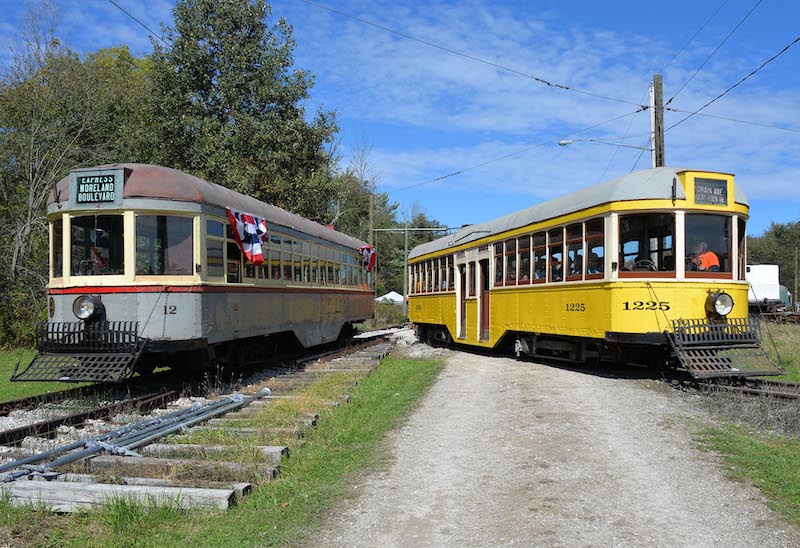
Two of the restored interurban and streetcars on display at the Northern Ohio Railway Museum in Medina County. (Credit: Northern Ohio Railway Museum)
By Ken Drenten
If you wanted to go someplace outside your city or town in Ohio from the 1890s to the 1930s, it’s likely that you’d catch a ride on what was called an interurban car.
These were electrically-powered trolley-like railcars that connected cities and towns, moving people, mail and cargo.
In an era when the horse and carriage was still in frequent use, automobiles were primitive and railroads were for long-distance travel, interurbans provided quick, efficient travel for shorter trips.
The Newark & Granville Street Railway, which began operation Dec. 28, 1889, is recognized as the first modern interurban line.
By World War I, Ohio had 2,798 miles of interurban track, more than any other state in the country. At its peak, every town in Ohio with a population of at least 5,000 was connected with other towns by interurban lines.
This network was not planned or operated by the government. Interurbans were commercial lines, run for profit on their own rail lines by privately owned companies.
Many times, they connected towns with recreational areas like Buckeye Lake, Blackhand Gorge and Lake Erie. Parks, lakes, hotels, restaurants, amusement parks, dance halls, concert venues and picnicking areas developed along and at the end of the lines.
But the dual effects of the Great Depression, highway improvements after World War I and the increasing use of automobiles, buses and trucks led to interurbans’ demise. By the early to mid-1930s, most interurban companies were out of business.
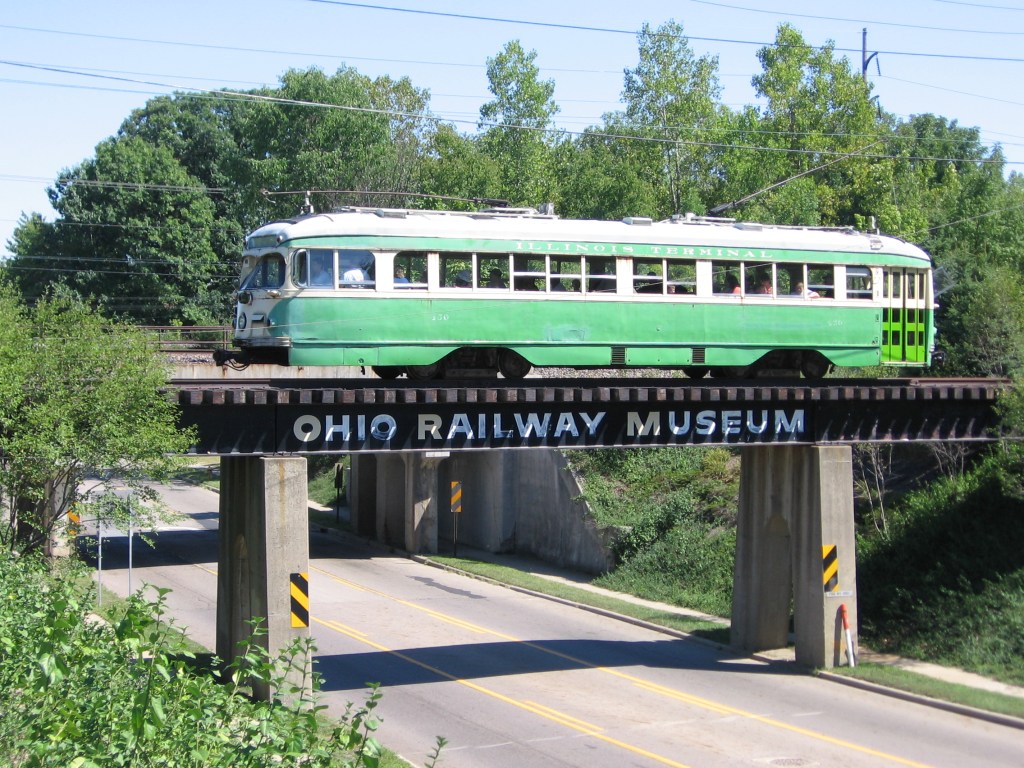
The Ohio Railway Museum in Worthington has several restored interurban railcars like this one that provide rides for guests. (Credit: Ohio Railway Museum)
Can you view or even ride in a restored interurban railcar today? Yes, you can.
The Northern Ohio Railway Museum in Medina County has more than 40 streetcars, interurbans, rapid transit cars and other rolling stock. Most are either operable or will be restored for operation on a 3-mile demonstration railroad track. Open Saturdays only from May to October. 5515 Buffham Road, Seville (330) 769-5501.
Ohio Railway Museum in Worthington features a collection of interurban cars and other historic rail vehicles, offering guided tours and special events, including rides. The museum operates on an historic railbed established in 1901 to provide essential passenger and freight services across 60 miles, connecting Columbus, Worthington, Delaware and Marion.
The museum’s collection includes CWD&M interurban parlor car #501, affectionately known as “The Red Bird.” Their collection also includes Ohio Public Service Interurban Car #21, listed on the National Register of Historic Places.
The museum is open Sundays through December from noon to 4 p.m. Admission is $10 for adults, $9 for seniors and military, $8 for children ages 4-12, free to children 3 and under. A ride on an interurban car is included in the admission price. The museum is located at 909 Proprietors Road, Worthington (614) 885-7345.
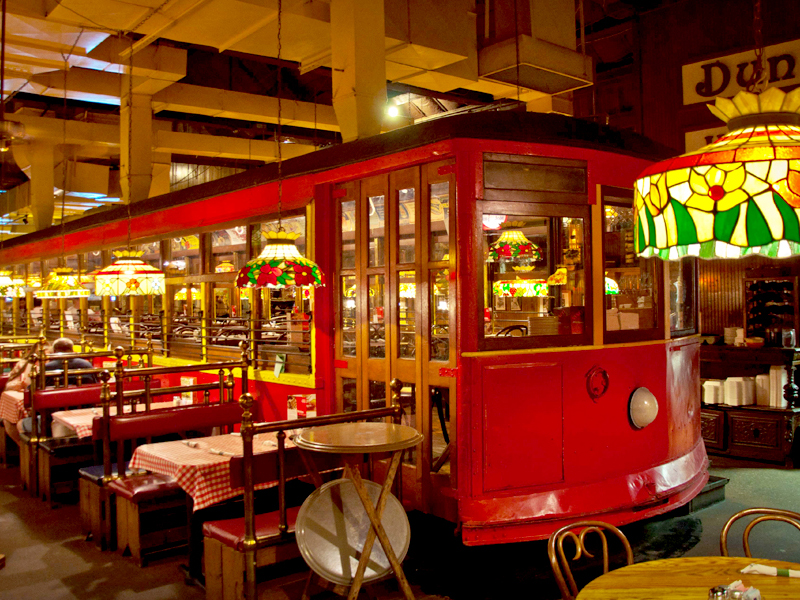
This streetcar rested in the Spaghetti Warehouse in Columbus for decades as a place to dine until the restaurant’s demolition in June 2025. A community group saved it and is renovating it as the centerpiece of a Columbus community park and cultural center. (Credit: Spaghetti Warehouse)
The Spaghetti Warehouse Trolley was saved from destruction in June 2025 when the restaurant building in Franklinton had to be demolished. Though not an ex-Columbus streetcar or interurban car, it was used for many years by the restaurant as a dining area.
The car is currently undergoing restoration by the Rickenbacker Woods Foundation and will become the centerpiece of a new park and interpretive area in the near east area of Columbus. The site, also the birthplace of World War I air ace Eddie Rickenbacker, will also honor inventor Granville T. Woods and the contributions of other Black Ohioans.
The area is envisioned as a public learning environment focused on transportation, invention, and African American innovation, as well as a center for storytelling, youth STEAM programming and cultural connection.
Find more railroad-related attractions in Ohio in Dusty Tires.
Here are several of the dozens of interurban lines that served Ohio:
Cincinnati & Lake Erie Railway (1930-1939): Born of mergers of several smaller lines, this was one of the largest and most profitable interurban lines in the entire country at one time. At one time its lines extended for some 200 miles from southwest Ohio into Indiana and Michigan.
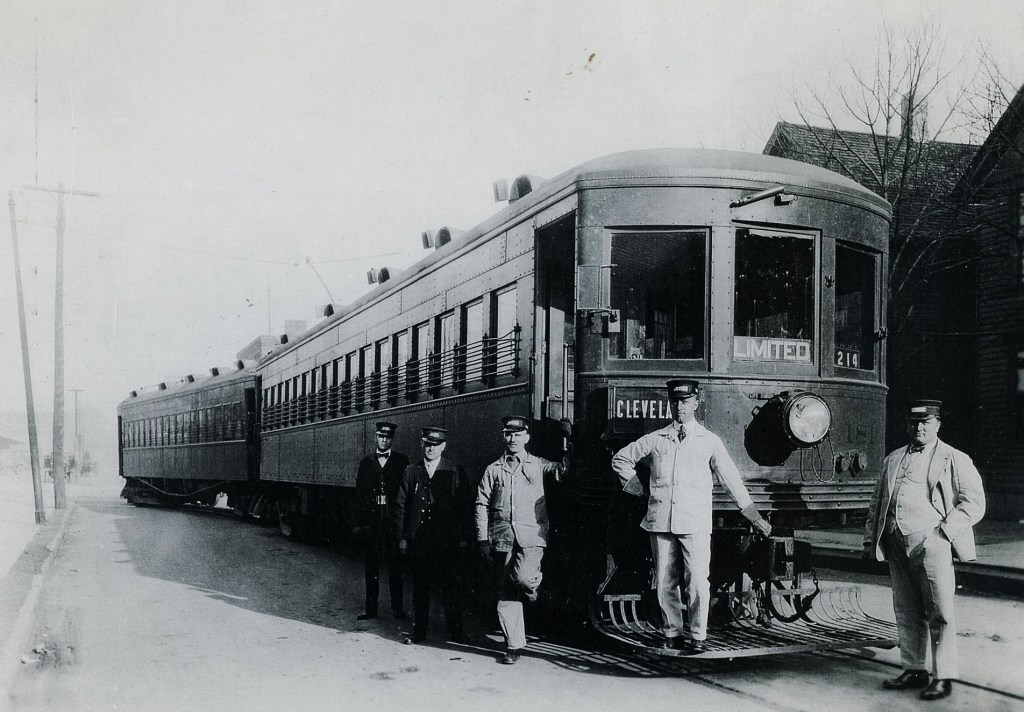
The crew of Interurban car #181 of the Lake Shore Electric Railway is shown above, circa 1930. (Credit: National Railway Historical Society)
Cleveland, Southwestern & Columbus Railway (1895-1931): This line began as a connector between Cleveland and Berea; in 1907 it added a line to Columbus. After 1931, its electric railcars were replaced with buses.
Columbus Consolidated Street Railway (1891-1948): This company was formed from many smaller companies serving the Columbus area, including those that had provided horse-drawn transportation since the 1850s. The company underwent many name changes, acquisitions and mergers. In 1914 the system became the Columbus Railway Power & Light Company, and after a series of transactions by 1937 became known as the Columbus & Southern Ohio Electric Company.
The line operated interurbans until they were replaced with buses in 1948. The bus line became operated by the Columbus Transit Company, which in turn was replaced by the public transit agency Central Ohio Transit Authority (COTA) in 1976. C&SOE continued to provide electric service in central Ohio. C&SOE in 1980 became part of American Electric Power, which provides electric service to more than 5 million customers in 11 states today.
Lake Shore Electric Railway (1901-1938): This railway was the result of mergers between four smaller lines in northern Ohio, later adding two more lines. At its peak the Lake Shore ran along the Lake Erie shoreline connecting Cleveland with Detroit via Norwalk, Fremont and Toledo. A 1938 strike forced the line to close.
Ohio Electric Railway (1907-1921): The Ohio Electric Railway lasted until bankruptcy, when the smaller operations that had formed it broke into 10 independent lines serving cities like Cincinnati, Columbus, Dayton, Hamilton, Lima, Springfield, Toledo and Urbana.
Sources: Ohio Memory – “Ohio’s Interurban Railways: The Original People Movers,” July 17, 2015; American Rails.
Ken Drenten is creator and editor of Dusty-Tires.com, a travel blog for out-of-the-ordinary places in Ohio.
Subscribe to Dusty Tires and receive a weekly email with the latest blog article. It’s free!
All rights reserved, Dusty Tires (dusty-tires.com), 2025.
 Dusty Tires
Leave a comment