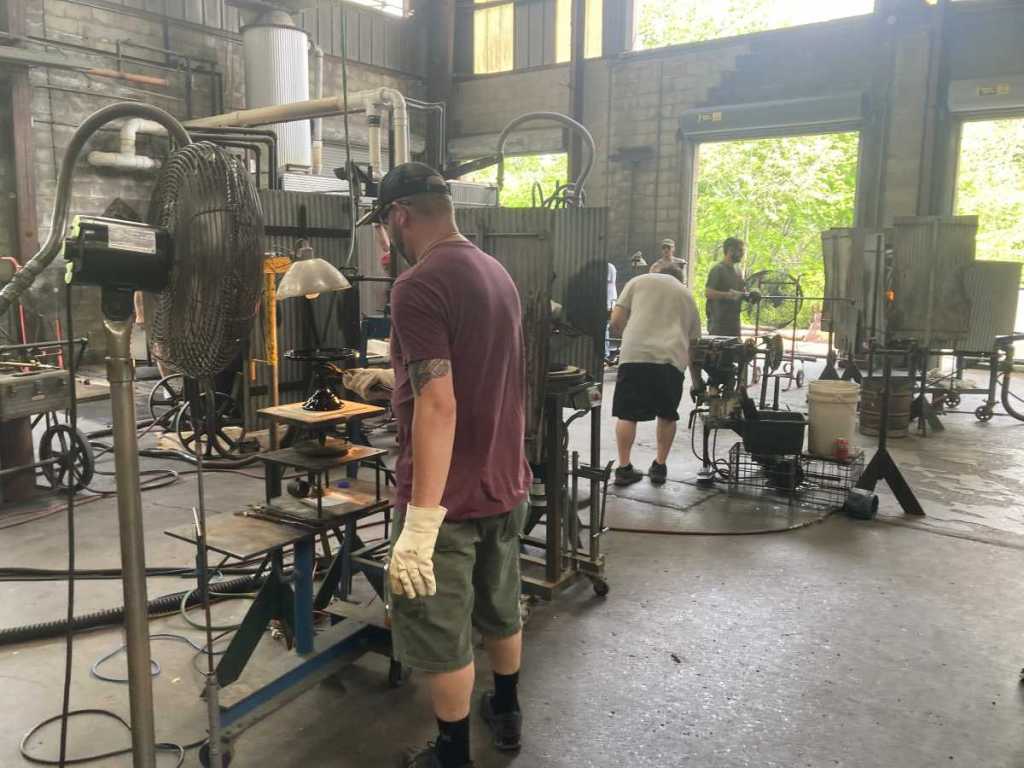
A tour of the Mosser Glass plant in Cambridge shows many talented factory employees at work pressing and blowing glass. (Credit: Ken Drenten)
By Ken Drenten
Taking a tour at Mosser Glass in Cambridge is like looking back into Ohio’s rich history of glassmaking. Ohio’s tradition in glassmaking dates back to its early days of statehood, with many glassmakers bringing their craft from New England and Europe.
Many museums in Ohio feature fine examples of Ohio glass, and glass manufacturing continues to be important in the state, mostly for commercial (windows, auto glass, etc.), industrial and medical applications.
Mosser Glass, however, is a throwback to the boom years of Ohio glassware produced and marketed for artistic and residential uses.
Mosser Glass, established in 1971, is a family-owned blown and pressed art glass manufacturer in Cambridge. The legacy of Mosser Glass ties directly to earlier glassmakers; they use classic designs acquired from Viking, L.G. Wright and Cambridge Glass.
Mosser glassware includes cake stands, mixing bowls, tableware, pitchers and tumblers, lamps, punch bowls and spooners, baskets, candleholders, glimmer lights, animal figurines, paperweights and holiday items.
Factory tours are available and a retail store is on premises. This tour is very informative, entertaining and worthwhile. The tour we took was provided by a family member that owns the company, and we saw many talented factory employees at work pressing and blowing glass. You can find Mosser’s plant and retail store at 9279 Cadiz Road, Cambridge (740) 439-1827.
A visit to Cambridge should also include the National Museum of Cambridge Glass, which features more than 10,000 pieces of beautiful handmade Cambridge Glass, produced by the Cambridge Glass Company from 1901 to 1958. It’s located at 136 S. Ninth St., Cambridge (740) 432-4245.
View the video above in YouTube. If the embedded video does not show up in an email, please use this link: https://youtu.be/pcDnxlYxqv4
A short history of glassmaking in Ohio
The state’s first “glass house,” or glass-making factory, was organized by a group of citizens and incorporated May 13, 1815, as the White Glass Works in Zanesville. Another glass works was built in 1816 in Zanesville, known as New Granite Glass Works.
The White Glass Works factory in 1822 became Shepard & Co., and in 1842 became Kearns & Co.; an additional plant was built in 1848 at Putnam, across the Muskingum River from Zanesville. These early glass plants mainly produced flasks, bottles and decanters.
By the 1850s many glass plants were being established in Ohio, including facilities in Kent, Mantua, Ravenna, Steubenville and Warren. A glass furnace was established in 1830 by Kilgore & Hanna in Steubenville, which developed into a world-class manufacturer of glass products.
Many glassmakers operated only for a short time due to economic conditions, mergers and other reasons. Belmont Glass Co. was founded in 1866 in Bellaire and operated until 1890.
From 1870 to 1880, many varieties of colored pressed tableware were produced in Steubenville; in 1888, the A.J. Beatty & Sons glassware company moved from Steubenville to Tiffin and merged with U.S. Glass Co. in 1892.
A boom in glass production started in earnest from 1880 to 1890, with Bowling Green, Findlay, Fostoria and Tiffin becoming notable centers. At one time, Findlay had 16 glass manufacturing plants, and Bowling Green had five. Glassmaking producers that were founded during this time included U.S. Glass Co. in Tiffin, Fostoria Glass in Fostoria, Heisey Glass in Newark and Robinson in Zanesville. The Robinson Glass Company existed from 1893 to 1900, when it was absorbed by the National Glass Company.
Undoubtedly the most successful Ohio glassmaker, Libbey Glass Co., was founded in 1818 in East Cambridge, Mass., as the New England Glass Co., and moved to Toledo in 1888. Libbey still maintains its headquarters in Toledo, known as “The Glass City,” and produces and markets glassware around the world.
Decorative cut glass and art glass became popular from 1890 to 1915; by 1920 consumer tastes were changing to simpler, well-designed tableware. Cambridge Glass in Cambridge, Imperial Glass in Bellaire, Heisey, U.S. Glass and Libbey are all examples of this type.
More places to learn about Ohio’s glassmaking history
Fostoria Glass Museum in Moundsville, W.Va. displays a collection of Fostoria Glass, produced from 1887-1891 in Fostoria, Ohio, and from 1891-1986 in Moundsville, W.Va. At one time, Fostoria Glass was the largest maker of handmade glassware in the United States. 511 Tomlinson Ave., Moundsville, W.Va. (304) 845-9188.
The Glass Heritage Gallery exhibits 10 different glassmakers that made glass in Fostoria from about 1887 to 1920. The museum is operated by the Fostoria Ohio Glass Association. 109 N. Main St., Fostoria (419) 435-5077.
The Heisey Glass Museum houses a gallery of Heisey Glass from its founding in 1896 to the closing of factories in 1957. Heisey was known for its fine quality tableware, decorative pieces and blown glassware called Heisey’s American Crystal. 169 W. Church St., Newark (740) 345-2932.
The Millersburg Glass Museum is the largest public display of Millersburg Carnival and Crystal Glass, produced in this city from 1909-1912. View more than 200 pieces of glassware. Operated by Holmes County Historical Society, 484 Wooster Road, Millersburg (330) 674-0022.
National Museum of Cambridge Glass features more than 10,000 pieces of Cambridge Glass. 136 S. Ninth St., Cambridge (740) 432-4245.
National Imperial Glass Museum, more than 3,000 pieces of Imperial Glass on display. Bellaire is home to what was once America’s largest glass factory. 3200 Belmont St., Bellaire (740) 671-3971.
Ohio Glass Museum & Glass Blowing Studio has exhibits on Ohio’s glass industry, gallery, gift shop, glass blowing demonstrations and workshops for individuals and groups, memberships. 124 W. Main St., Lancaster (740) 687-0101.
Tiffin Glass Museum & Shoppe — Tiffin Glass Museum honors the heritage established by the men and women of Tiffin’s “Glass House.” Museum exhibits include examples and documents from the factory beginning in 1889 until its closing in 1984. 27 S. Washington St., Tiffin (419) 448-0200.
If you’d like to learn more about Ohio glass or even try your hand at glassblowing, there are a number of places that offer demonstrations, classes and workshops. Find them in Dusty Tires.
Source for historical information: “Ohio Glass,” Toledo Museum of Art, 1953, and “Bottles and Extras,” Winter 2004 issue.
Ken Drenten is creator and editor of Dusty-Tires.com, a travel blog for out-of-the-ordinary places in Ohio.
Subscribe to Dusty Tires and receive a weekly email with the latest blog article. It’s free!
All rights reserved, Dusty Tires (dusty-tires.com), 2025.
 Dusty Tires
Leave a comment