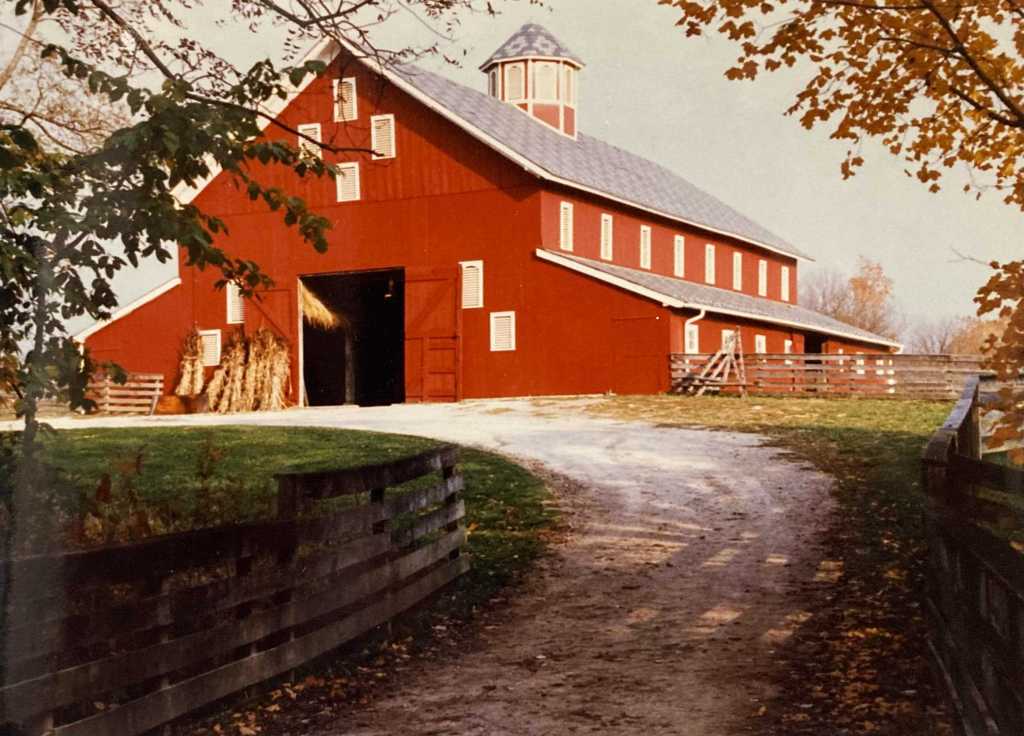
Slate Run Farm’s barn was built in 1881 and restored in the 1970s by Amish carpenters. (Credit: Ken Drenten)
By Ken Drenten
When my kids were growing up in the 1990s, Slate Run Living Historical Farm was a great place to take them to let them experience a slice of old-fashioned living. They loved the tree swing and a marble race game, as well as watching and helping costumed interpreters prepare meals and do chores around the farm.
And you know what? It still is a great place. Now that my grandchildren are growing (five grandkids ages three months to nearly 9 years old), I’m looking forward to revisiting this place with them soon.
The farm recreates the agricultural lifestyle of the 1880s. The original farm, located in northern Pickaway County near Lithopolis, was established in the 1850s and was abandoned by the 1960s or early 1970s. The Gothic Revival farmhouse was built in 1856 and its magnificent barn was built in 1881.
Franklin County’s Metro Parks system acquired the farm and its 300 acres in the 1970s, including the farmhouse and barn. The farmhouse and barn were restored to their working-days appearance and were added to the National Register of Historic Places in 1975. The farm opened to the public in 1981.
At the farmhouse, guests can tour the living room, parlor and kitchen and watch people prepare meals and tend to household chores. The multi-bay barn was built by Samuel Oman, the fourth owner of Slate Run Farm, and restored by Amish carpenters.
Costumed staff work at the farm, growing vegetables, preparing meals and tending livestock, and teaching visitors about Ohio’s agricultural history. Vintage tools and farm machinery are used and heirloom vegetables are grown. Guests can view and interact with farm animals, including cows, ducks, geese, chickens, turkeys, pigs and goats. Sturdy Percheron horses are used for farm work.
Planting, growing, and harvesting are all done with methods from the 1800s. Meats are smoked and preserved in a smokehouse, vegetables and fruit are canned, and food is cooked on wood-burning stoves. Water comes from a hand-pumped well. Apples are squeezed into cider using an authentic hand-cranked cider press. Molasses is made from harvested sorghum using a mule-operated press. There are period-authentic toys to play with in the yard and inside the house.
The historic farm is part of 1,075-acre Slate Run Metro Park, that features numerous walking and biking trails through grasslands, wetlands, forests, and meadows. The park’s main water feature is Buzzard’s Roost Lake, while nearby Slate Run Creek passes through the park. Amenities include picnic areas and shelters, boardwalks and fishing docks, and several sets of play equipment. Sandhill crane have nested in the 156-acre wetland, and northern bobwhite quail have been reintroduced in the park.
Other nearby attractions include Slate Run Vineyards, 1900 Winchester-Southern Road, Canal Winchester; the Village of Lithopolis, featuring the Wagnalls Memorial, and the Bergstresser Covered Bridge, built in 1887, located at County Road 224 west of SR 674, 1 mile south of Canal Winchester.
Slate Run Living Historical Farm is located at 1375 SR 674, Canal Winchester (614) 833-1880.
Learn about other historic farms and barns in Dusty Tires.
Ken Drenten is creator and editor of Dusty-Tires.com, a travel blog for out-of-the-ordinary places in Ohio.
Subscribe to Dusty Tires and receive a weekly email with the latest blog article. It’s free!
All rights reserved, Dusty Tires (dusty-tires.com), 2025.
 Dusty Tires
Leave a comment