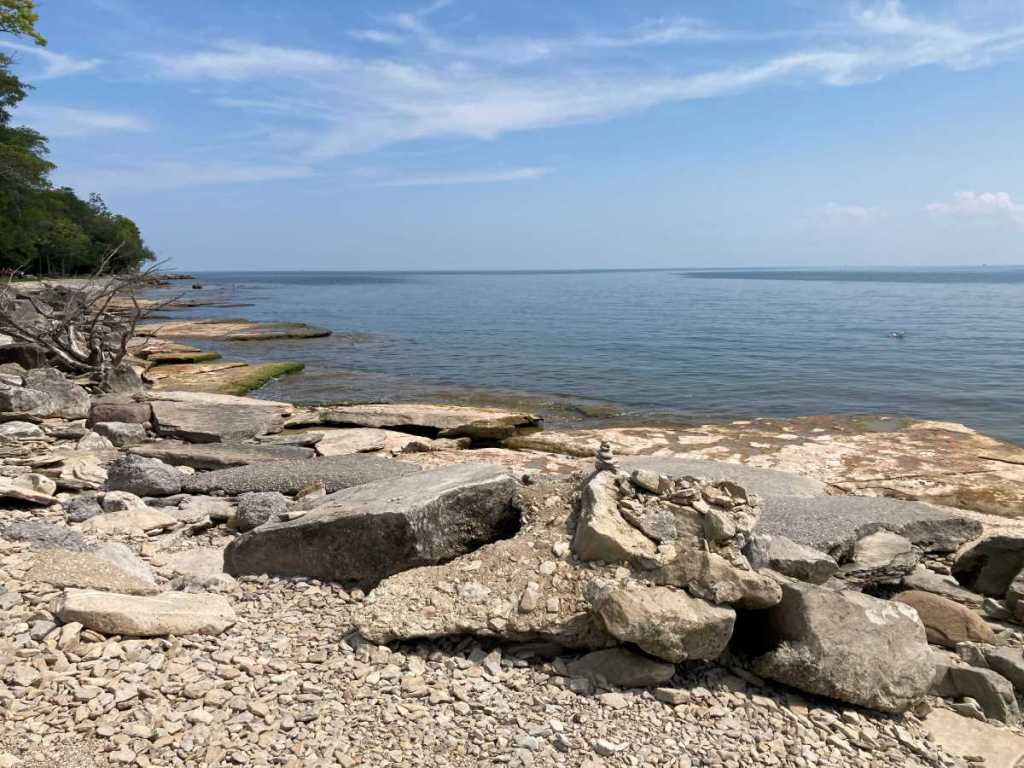
A view of Lake Erie from the western shore of Kelleys Island. (Credit: Ken Drenten)
A Dusty Tires Short Story
By Dusty Tires
Part 2
Lawson trained his eyes on a white spot about 600 to 700 yards out. In the binoculars, the spot became a partially sunken sailboat with two boaters hanging on in desperation.
“Small craft capsized with two in the water,” he said. “They’re hanging onto the boat.”
“Is there anyone else in the area?”
Lawson looked around. “No, I don’t see anyone. Everyone else has skedaddled.”
Murphy picked up the receiver and clicked over to the U.S. Coast Guard channel. “Coast Guard, Coast Guard, this is Esther Belle, MV-1028. We have an emergency, repeat an emergency. Sailboat sighted capsized in the water approximately 600 yards to our port bow, two in the water. Repeat, two in the water. We are located approximately two and a half miles south of the Kelleys Island Ferry Lines dock. Please acknowledge and advise. Esther Belle, MV-1028, over.”
The radio responded immediately. “Esther Belle, this is U.S. Coast Guard. Please provide your bearing numbers. Advise you approach craft in distress and stand off at 75 yards to support rescue operations. RB-M Erie is responding to assume rescue operations. ETA in 12 minutes. Erie will advise when they arrive. U.S. Coast Guard, out.”
The U.S. Coast Guard Response Boat-Medium (RB-M) Erie was a 45-foot boat with a top speed of more than 40 knots and a deep-V, double-chine hull, allowing a balance of performance and stability. The vessel was self-righting, meaning that if it capsized in rough seas, it was designed to right itself.
The Erie, propelled by twin jets, could handle heavy seas with waves up to 12 feet and carry up to 24 people, including its crew of eight. The boat was the flagship of the small station’s fleet of four rescue boats. It was this craft and its crew that responded within minutes of receiving the call from M.V. Esther Belle.
Aboard the Esther Belle, passengers were pointing out the windows of the port side of the ferry as they put on life jackets and huddled together in groups. The word had gotten out quickly that the ferry was altering course slightly to approach the boat in distress. They could see two figures in the water. One of them was waving to the ferry.
Murphy nodded toward Lawson’s pocket. “Can I borrow some of that?” he asked.
Lawson wordlessly tossed over a pouch of chewing tobacco to Murphy. He knew Murphy had given up the nasty habit years ago, but this was no time to be needling him. He dipped into it himself after Murphy handed back the package.
“Boss, take a look off to the port side, behind us,” Lawson said. “It’s the Coast Guard.”
Sure enough, the RB-M Erie was plowing through the water at what seemed to be breakneck speed compared to the sloth-like pace of the ferry. The boat had crossed the ferry’s wake behind it, and was coming up alongside it now, about 100 yards away.
The Coast Guard craft slowed as it approached the sailboat. Murphy ordered the engines to half-speed, and the ferry barely made headway in the waves as it waited for the rescue to be carried out in front of it.
Murphy could sense something different about the roiling water around the ferry. It felt like he was pushing the craft through gravy. The air seemed to be full of wind, spray and electricity. His hands had to grip the wheel tightly to maintain course.
Just then, a terrific gust of wind rocked the ferry and pushed a mountain of water over the gunwales of the RB-M Erie. The wheel wrenched in Murphy’s hands, but he was able to keep the ferry in control as it rocked and rolled from the wave surge. The ferry slanted about 10 degrees, and he could hear passengers shouting. The ferry righted itself, but Murphy and Lawson could only watch in dread as the Erie disappeared below the waves.
After a few heartbeats, the Erie rocked back up dramatically and settled itself in the water. “That looked like a whale breaching the water – incredible!” Murphy said. “Lawson, check the passengers and make sure everyone is OK after that big wave.”
Lawson nodded. Within a few minutes, a small inflatable boat launched from the Erie was heading toward the two in the water. Three Coast Guardsmen were in the boat; as the boat approached, they threw a life ring toward the pair in the water. One of the people grabbed it and put it on the other, who was pulled aboard the boat.
Not long afterward, the second one was safely aboard the inflatable, which then turned and dodged waves back to the Erie. The rescue, done as professionally as ever by the Coasties, was over in about 10 minutes.
Murphy heard scattered applause from the passengers below. Lawson came back up. “Deckhands report that everyone’s OK,” he said. “A couple of vehicles bumped into each other, but there’s no major damage.”
“We’re not out of the woods yet,” Murphy said, looking toward Kelleys Island. He could barely see the island’s outline in the darkness, wind, rain and spray. The initial surge of the storm’s winds had passed by, but the storm was still all around them. “We have about a mile and a half to go.”
Lawson was about to agree when the engine room phone rang. Lawson picked it up. It was one of the diesel mechanics. He spoke into the phone briefly, and then turned to Murphy.
“Not good, eh?” Murphy said.
“No,” Lawson said. “We need to shut down Engine 1 or else we’re going to lose it for good.”
“Tell them to shut it down,” Murphy said. “We’ll make it on three.”
They watched as the Coast Guard rescue boat motored past them back to Marblehead, carrying its passengers safely back to shore.
“Boss, there’s something else,” Lawson said. “We’re taking on water.”
“How much?” Murphy asked.
“There’s a foot of water down there. They said the pumps are barely keeping up now, and with one engine down, we may be taking on water faster than we can pump it out.”
“Get down there and take a look yourself, then call me and tell me what’s going on,” Murphy said.
A few minutes later the phone rang in the pilothouse.
“We’re up to a foot and a half of water now, and we now have two pumps burned out,” yelled Lawson on the phone.
Murphy looked out into the wildly pitching seas and the island beyond.
“OK, just do the best you can do to keep the two other pumps working,” he said. “And let’s not lose any more engines.” At that moment, the radiophone from shore rang. He picked it up.
“M.V. Esther Belle, MV-1028, Murphy here.”
“Esther Belle, this is Kelleys Island dock. The storm has damaged the dock. The ferry can’t land here,” said a panicky voice.
“Who is this?” demanded Murphy.
“This is Nakimba, Abigail Nakimba. I’m a dockhand.”
“Yes, Abbie. You’re sure we can’t make landing there?”
“Captain, if you try landing the ferry here, you’ll smash it up for sure. The dock and ramp is all torn up.”
“What about the Kelleys Islander, is she safe?” asked Murphy.
There was a moment that he could hear the question being asked in a flurry of noise in the background. “The Kelleys Islander is safely docked back at Marblehead,” Nakimba responded.
Another voice came on the radio. “Captain Murphy, this is Sgt. Henson, Kelleys Island Police Department. You’ve got a bad situation here. Like Abbie said, the dock is badly damaged. There’s no way you can safely land the ferry here. It’s just not possible.”
“Ok, thanks for the warning. Listen, we’ve got one engine and two pumps down and we’re taking on water. We are fine with three engines but I’m concerned about our flooding situation. We’ll advise, over.”
Murphy got back on the phone to the engine room. “Lawson, I need you back up here. We can’t land at Kelleys Island. We’re going to have to turn around and head back to Marblehead. And we need to advise the Coast Guard of that, and that we’re now in distress.”
The boat made a wide turn in the stormy waters and began its ponderous way back to the mainland. The dim outline of Marblehead and safety on the Ohio mainland looked farther away than he could ever remember it looking before.
Before long, the RB-M Erie was back alongside the ferry, bouncing in the waves. “M.V. Esther Belle, we are ready to offer assistance if you need it, over,” said a voice over the radiophone.
Murphy waved at the boat from the pilothouse. He wondered what the little boat would be able to do if the ferry actually began to founder in the rough seas. He hoped he wouldn’t have to find out.
Now the ferry was making about 6 knots, churning sluggishly back toward Ohio in the stormy seas. Jeffries, the bosun, had been instructed to give updates every 10 minutes on the condition of the engines and the pumps. So far, the remaining engines and pumps were holding up, but the water level was up another half a foot.

The LaFarge Limestone loading conveyor loads a ship at the Marblehead dock. (Credit: Ken Drenten)
Soon Murphy could discern the outline of the LaFarge Limestone loading conveyor that extended far out from shore to the starboard. With its rock foundation, it was solidly absorbing the pounding of the waves from the west, and that was encouraging as well as helpful.
Lawson took another call a few minutes later. “Jeffries says Engine 2 is making the same noise the other one did before it quit,” the first mate said.
“Tell him to give me just a few more minutes,” Murphy said between clenched teeth. “If you please.”
The minutes passed slowly, and the ferry crept into the harbor. The storm was noticeably abating now, and Murphy felt the worst was over. The Coast Guard boat radioed that it was going back to station, and Lawson acknowledged.
When the M.V. Esther Belle finally locked into the dock at Marblehead, Murphy let go of the wheel and slumped into his chair. An Erie County Sheriff’s Department cruiser, two Danbury Township Fire Department trucks and an ambulance were waiting at the dock, along with dozens of anxious-looking people. He turned to Lawson.
“Make sure everyone gets off safely, and tell them we’ll refund their money,” he said. “Make sure there’s no one hurt. I’ll find out how many people are over at Kelleys Island, and make sure they have somewhere to stay tonight. You get things battened down here and get our people home. This boat is done for the day. And we’re closed tomorrow. We need to make repairs to the island dock and to this boat.”
When he finally got back to his office two hours later, Murphy sat down at his desk and looked out the window at the dock and the ferry. The two boaters had been taken to the hospital for bumps, bruises, hypothermia and shock. Two ferry passengers had been treated at the scene for hypothermia, and one of the deckhands had suffered some bruises, but there had been no serious injuries. For that, he was relieved.
It was now evening, and the storm had passed. They had left 32 people on the island for whom they would have to pay for overnight lodging, but it had worked out. Murphy had quite a bit of paperwork to complete after this eventful day, but he decided it would have to wait until tomorrow. He was exhausted beyond comprehension.
Lawson looked in. “One of those days, huh, boss?”
Murphy nodded and waved. “Yep. One of those days. Hey, thanks for everything you did today.”
“You bet. Thank you, too,” Lawson said. “You all right?”
“Yeah, I’m just about ready to go home. Nothing else I can do here tonight.”
Lawson was about to leave, but there was another person at the door. It was a uniformed Coast Guard officer. Murphy was mildly surprised, since the Coasties rarely came to his office. If he was in trouble, they would summon him to the station.
He stood tiredly. “Lieutenant Bennington, this is a surprise. This is my first mate, Jim Lawson. How may I help you, sir?”
The officer took off his hat. “Captain Murphy, I think you already have. I just came in to thank you and your crew for what you did today.” He nodded toward Lawson.
“We did what anyone else in our position would have done. Anyway, your boys did the heavy lifting. I always admire watching a good rescue. Is everyone on your crew all right?”
Bennington nodded. “They’re all right. And so is my brother-in-law and his teenage son. They were the ones in the water today. I’ll buy you guys a beer some time when you’re not so exhausted. And I’ll bring my idiot brother-in-law along and have him buy you one, too.” The officer held out his hand.
Murphy grinned as he gripped the lieutenant’s hand. “I think my first mate here and I will take you up on that offer, Lieutenant. I believe we will.”
Ken Drenten is creator and editor of Dusty-Tires.com, a travel blog for out-of-the-ordinary places in Ohio.
Subscribe to Dusty Tires and receive a weekly email with the latest blog article. It’s free!
All rights reserved, Dusty Tires (dusty-tires.com), 2025.
 Dusty Tires
Leave a comment