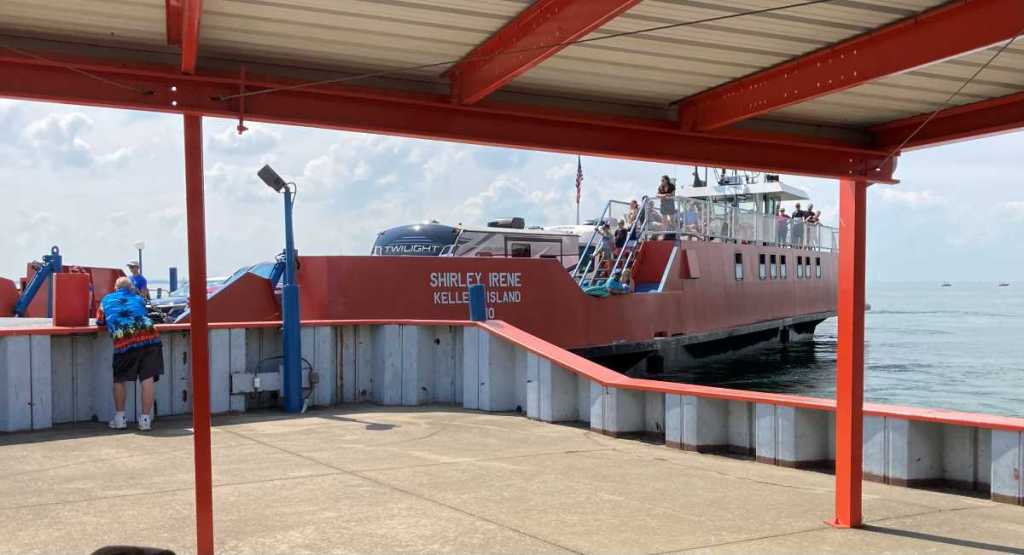
The Kelleys Island ferry M.V. Shirley Irene. This fictional story is modeled in part on the voyages of ferries like these. (Credit: Ken Drenten)
A Dusty Tires Short Story
By Dusty Tires
Part 1
Bill Murphy woke up at his usual 5:30 a.m. on a Tuesday in August and got up from his couch in the living room in his bungalow in Marblehead, Ohio. A half-empty Maker’s Mark bottle sat on the coffee table next to him. He capped the bottle, retrieved yesterday’s Sandusky Register newspaper from the floor to the coffee table, and stumbled into the bathroom.
He regarded the salt-and-pepper stubble on his face with mild disdain in the bathroom mirror. Picking up a razor, he hesitated, then decided to leave his face the way it was. He wet his graying sandy-brown hair and ran a comb through it after splashing his face with soapy water.
Walking into the kitchen, he turned on the weather radio on top of the dinette, then started coffee and rummaged in the refrigerator for some milk for his cereal. He had forgotten to get milk the day before, so he decided on toast instead.
Murphy was captain of the M.V. Esther Belle, a 165-foot, quad Caterpillar diesel-powered ferry that operated from the Marblehead pier to the southernmost point of Kelleys Island, about four and a half miles across Lake Erie.
Every day during the high tourist season of summer, the ferry and its twin, the M.V. Kelleys Islander, each churned the waters 12 times each day, making one round trip every hour. That allowed tourists, contractors, suppliers and workers to make a trip either to or from the 4-1/2-square mile island every half-hour, from 9 a.m. to 9 p.m.
The captain had been ferrying all his life, as had his father before him. He’d started as a soda pop machine wrangler as a teenager, and now, at age 55, he operated a boat himself. Not only that, he was the owner and operator of the two-vessel company. Each ferry could hold about 150 passengers and up to about 35 automobiles, trucks and recreational vehicles.
He walked with a weather-beaten Sohio travel mug full of coffee out the back door to his pickup truck to make the five-minute commute to the Marblehead dock. He could view the docks and lake from where he lived, and he didn’t like today’s dark clouds that were moving across the sky. The weather report today was calling for scattered storms, possibly severe at times. He disliked uncertain forecasts, because on Lake Erie you could never tell exactly when storm winds would turn the water from placid to ferocious.
Lake Erie is the perhaps the busiest of the Great Lakes. With Toledo and Detroit on the western end, Cleveland and Erie roughly in the middle, and Buffalo at the eastern end, the lake has long supported the heavy industry of the United States. Lake Erie has provided the solid backbone for the transportation of coal, iron ore, limestone and other industrial raw materials.
It also supports a thriving sport fishing economy, with fleets of pleasure and fishing boats plying its waters in search of walleye, perch, bass and weekend recreation.
The waters of the lake are shallow in comparison to the other Great Lakes, and it extends lengthwise west to east, so Erie is susceptible to storms and winds. A storm that builds in the western basin can create dangerous waves further east that can strike with little warning.
Murphy, a veteran of the lake, knew all that. It was just as much a reality as was the boom-and-bust cycle of the tourist businesses that flourished all summer and shut down each fall in the area known as “Ohio’s Vacationland.” Parking the truck, he unlocked the door to a dockside building that had a sign stating “KELLEYS ISLAND FERRY CO.” over the door.
He turned on the light, and then switched on the TV, which was always tuned to the Weather Channel. He took a sip of coffee as he went into his office and started more coffee in an electric coffee maker. Then he punched a button to make a call.
“Jim, this is Bill. Sorry to call so early. Would you mind getting here a little earlier than usual? Oh, you’re heading out now? Great. You know, that engine noise on Number 1 we talked about yesterday still bothers me . . . I know they did. But it wouldn’t hurt to try tracking it down again after the engine’s been cold. Can you have Al and Marty here early too? Thanks, Jim, I appreciate it. Yeah. Bye.”
Jim Lawson, in his mid-40s, was Murphy’s right-hand man and the first mate of the ferry. He supervised a boatswain’s mate, Jeffries, and a crew of two diesel mechanics, four deckhands and the four dock personnel who handled the vessel and its loading and unloading on each trip.
Lawson, a wiry man with close-cropped hair under an ancient, oil-stained Red Man Tobacco ballcap, walked in the door about 10 minutes after Murphy himself had entered. He yawned greatly and sat down in a chair in front of Murphy’s desk. He drank a gulp of coffee after refilling his cup from the office coffee maker.
“Boss, you know we went over every square inch of those engines yesterday,” he said. “We couldn’t find nothing wrong.”
“I know,” Murphy admitted. “But those engines are 20 years old. You’d better check ‘em again, Jim.”
“Aw, you know we will,” Lawson said. “I’m just saying…”
“Better keep an eye on the weather today, too,” Murphy said.
“Yeah. Don’t I always?” Lawson said with a grin. “Might be some bad storms today, right?”
“I hope not, but yeah, it could get rough today. What else is new? Well, we better get going. Where are your two crack mechanics?”
By 8:15 a.m., the morning sun was bright and warm. Fueling was completed, and the vessel’s engines had been checked and primed for the start of the day. Vehicles were lining up on the dock waiting to be allowed on the ferry.
In the pilothouse high above the floor of the ferry, Murphy looked out of the windows at the lake and the island beyond. He checked the steering gear, lights, horn, engine room phone, the radiophone, the radar, the portable TV set, the weather radio, and the rest of his first-passage checklist.
When this was completed, he caught Lawson’s attention on the deck. With a thumb up, Lawson let him know his own pre-launch check had been completed. Lawson gave some instructions to Jeffries, and the vehicles and passengers started to roll onboard. Murphy got on the radiophone and called in to the U.S. Coast Guard station in Marblehead.
“U.S. Coast Guard, this is Esther Belle, MV One Oh Two Eight, preparing to launch for Kelleys Island at 0900,” he said.
A crisp reply came back. “Esther Belle MV-1028, this is U.S. Coast Guard Station Marblehead. Lieutenant Bennington here. You are clear to launch at 0900. Be sure to observe the special weather statement and as always, let us know if you have any issues. Have a good day. Over.”
“U.S. Coast Guard, aye-aye. We’ll keep a weather eye out,” Murphy said. “Have a good day, lieutenant. Over.”
When loading was completed, the ferry pulled away from the dock, churning toward Kelleys Island in the distance. A breeze was moving the gulls that floated above the boat as it made its usual way across the lake. Passengers either waited in their vehicles or got out and looked out over the gunwales of the ferry at the lake all around them. The gray-green water splashed alongside the ferry as it sliced through the water, and people laughed and joked with each other. Murphy took a sip of his now-cold coffee.
Soon, the ferry deposited its first load of passengers at the Kelleys Island dock. Murphy knew that by now, Lawson had sent the most junior of the deckhands to the Kelleys Island Marina nearby for another round of coffees for himself, Lawson and Jeffries. Lawson appeared in the doorway of the pilothouse not long after he’d had this thought.
“Here you go,” Lawson said, handing him a tall foam cup of hot coffee. Murphy nodded his thanks.
“Weather report hasn’t been getting any better,” Murphy grumbled. “Now they’re calling for winds of 35 to 45 knots an hour, gusts up to 55.”
“When?”
“Late this afternoon, maybe 5 or so,” the captain replied.
Lawson took a sip of his own coffee. “With any luck, we’ll be at Marblehead when it hits and we won’t have to make a tough decision,” he said. “Some people might have to spend a little longer than they want on the island.”
“That hasn’t happened to us in years, and it won’t happen today,” Murphy said, tightening his jaw. “We won’t leave people stranded.”
Murphy kept his ear to the monotonous reports from the NOAA weather radio as he piloted the ferry back and forth from the island to the mainland. Each trip took a little more than a half hour, including loading and unloading. He ate lunch in the wheelhouse, munching a ham and cheese sandwich, a bag of chips, an apple and a Diet Mountain Dew.
After lunch, Lawson relieved him in his piloting duties for one back-and-forth trip, which allowed him to visit the restroom and stroll around the deck to converse with passengers – his favorite part of the job.
When Murphy resumed his duties at around 3 p.m., he noticed the wind had picked up considerably, and the sky had grown noticeably darker, with thick dark gray clouds looming on the western horizon. The water was getting choppier, and he felt a strong side-to-side swell of the waves. He got on the engine room phone. “Mr. Lawson,” he called.
Lawson knew that Murphy only called him by that honorific when things got serious. “Yes, sir?”
“It’s getting a bit more active out there. I’d like a second set of eyes on the radar and binoculars up here if you don’t mind. And Have Mr. Jeffries and his deckhands ask all passengers to get in their vehicles if they drove over, and to seats if they are on foot. Have the deckhands make sure life jackets and safety gear is out and ready for use.”
“Will do. I’ll be up in one minute.”
Lawson came up from the noisy engine room where he had been conversing with the diesel mechanics, who had been hearing that mysterious noise from Engine 1 again. The stiff wind nearly blew his Red Man hat from his head as he scrambled onto the deck and up the steep stairway to the pilothouse. Passengers looked at him with questions in their eyes as he hurriedly walked past.
“Yeah, it’s starting to get interesting, huh?” he said to Murphy, glancing at the radar.
The radar screen did not look good, and what Lawson saw through the windows looked even worse. The lake was now whitecapped gray, with waves that rocked the ferry such that he had to lock his legs to keep his balance. The clouds in the sky were now darkening from a brooding gray to an angry black and purplish color in places, and the rumbles of thunder and flashes of lightning were getting closer.
“Here, take these glasses and tell me if you see something ahead just off the port bow, about 11 o’clock,” Murphy said. “My eyes aren’t what they used to be.”
Lawson looked. What he saw made his throat tighten.
Read Part 2 on June 5: Conclusion
Read more: Kelleys Island is Ohio’s unique Lake Erie getaway – July 16, 2024
Ken Drenten is creator and editor of Dusty-Tires.com, a travel blog for out-of-the-ordinary places in Ohio.
Subscribe to Dusty Tires and receive a weekly email with the latest blog article. It’s free!
All rights reserved, Dusty Tires (dusty-tires.com), 2025.

 Dusty Tires
Leave a comment