By Ken Drenten
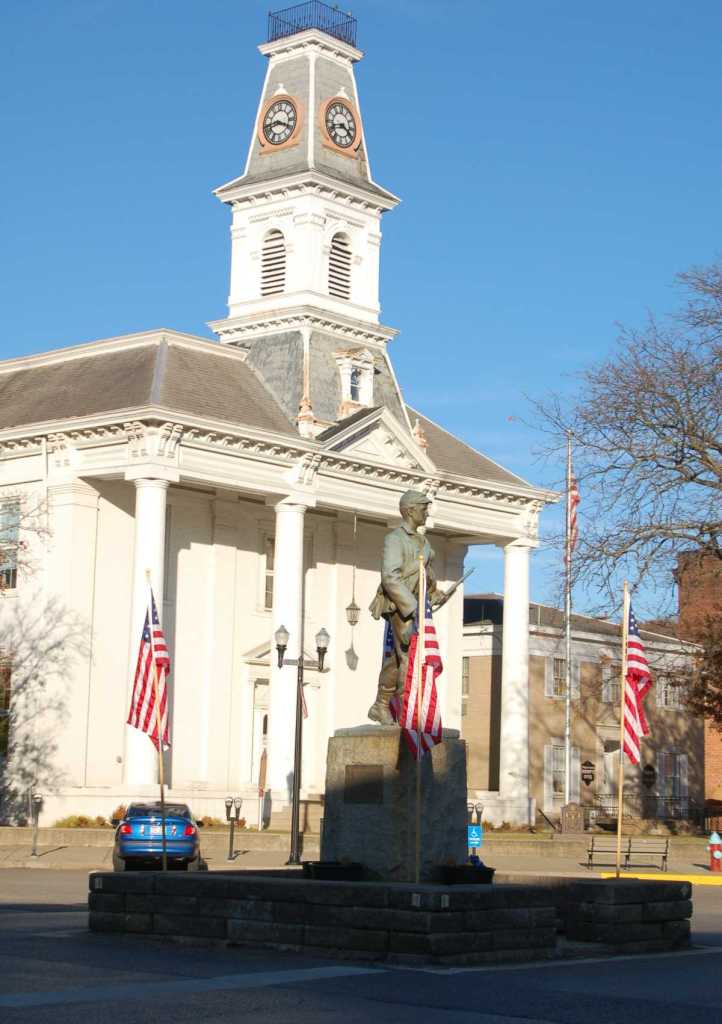
McConnelsville’s town square features a Civil War soldier monument. (Credit: Ken Drenten)
A handful of Ohio’s smaller cities and larger towns have something in common – a central town square or town circle.
Chagrin Falls, Chardon, Coshocton, Medina, McConnelsville, Millersburg, Mt. Vernon, Nelsonville, Newark, Somerset, Sunbury, Painesville and Urbana all have this feature, as do Carrollton and Mesopotamia. In the latter two towns, the central features are elongated greenspaces (known as “commons”) that stretch for several blocks. I’m sure there are more Ohio towns with variations on the town square feature.
Ohio’s great cities of Cincinnati, Cleveland and Columbus all have central areas based on the concept of a town square. Ohio’s state capitol building is itself located on a large square greenspace.
The practice came to America from European settlers, who created town squares most prominently in New England and along the East Coast.
Traditionally, town squares, or greens, were centrally-located areas where people came to meet and where most commercial and local government activity was located. Many times, central open-air markets were set up on a regular basis for people to purchase fresh produce and other goods.
Town squares were also used for defense — a town’s militia could use them to practice and to gather against outside threats. In Massachusetts, the Revolutionary War started at the town squares of Lexington and Concord when local militia mustered to face British regulars in April 1775.

Mt. Vernon’s park-like town square features a Civil War soldier monument. (Credit: Ken Drenten)
When later generations of New Englanders moved to Ohio as pioneers, refugees and soldiers receiving land grants after the Revolutionary War, the idea of town squares came with them. The concept was used in many new towns.
The areas of Northern Ohio known as the Western Reserve and the Firelands have communities that resemble New England towns because Connecticut once laid claim to those lands and sent settlers there prior to Ohio statehood. Virginia once had claims on lands that became the state of Ohio in southern and eastern parts of the state.
Today, these town squares can be seen as quaint throwbacks to an earlier time and possibly impediments to traffic. They usually have a centrally-located statue of some important personage, typically a soldier, in the middle of a park-like area.
Mount Vernon’s town square features a statue of a Civil War soldier known as the Knox County Civil War Soldiers Monument. The statue was erected on July 4, 1877, by the Mount Vernon Ladies’ Monument Association. Other markers are located nearby.
McConnelsville’s town square also features a Civil War soldier. The 13-foot statue is cast in bronze and depicts a typical private. The monument was donated to the town by Detroit industrialist T.H. Simpson to his hometown and was dedicated Oct. 17, 1923.
In Somerset, the village center features a statue of Civil War General Philip Sheridan, who was raised in the town. Sheridan is heroically posed on a rearing horse and holding his hat in the air. The statue was raised in 1905.
What I like about town squares is that they are not just roundabouts designed to help traffic flow more smoothly. They force you to slow down, look around and take some time to appreciate a town that you might otherwise speedily drive past or through. And remember, yield to the vehicle to the left!
Subscribe to Dusty Tires and receive a weekly email with the latest blog article. It’s free and ad-free!
Ken Drenten is creator and manager of Dusty-Tires.com, a travel blog for out-of-the-ordinary places in Ohio.
Copyright 2023, Dusty Tires (dusty-tires.com)
 Dusty Tires
Leave a comment