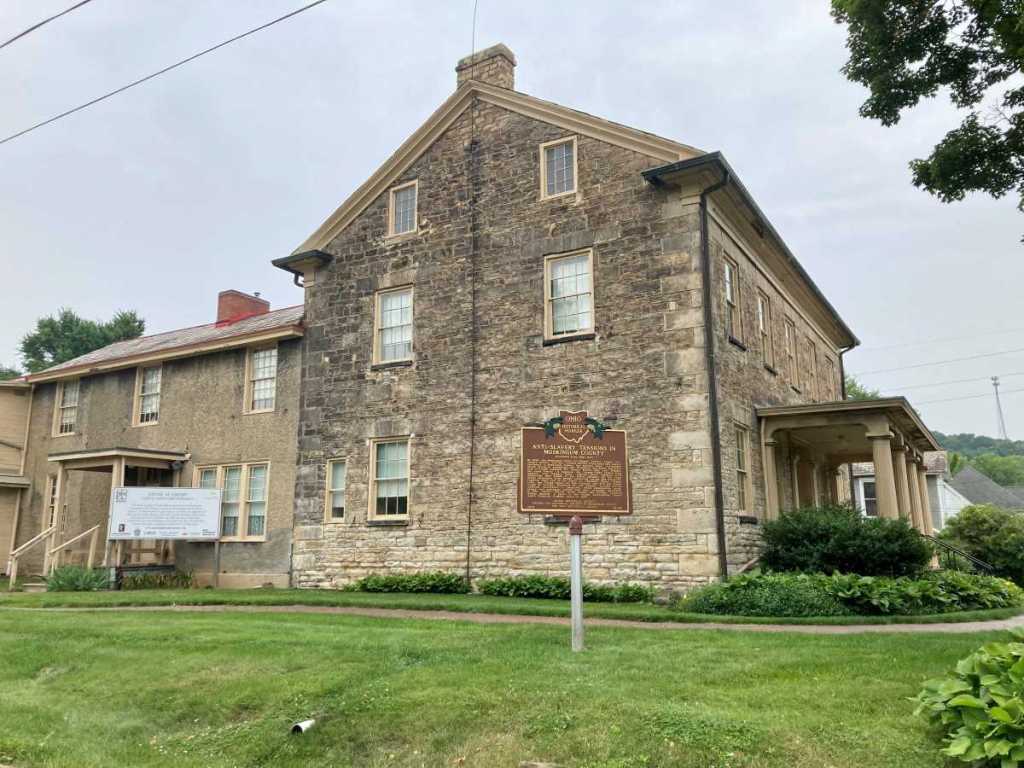
The historic Stone Academy was the center of abolitionist activity and a stop on the Underground Railroad in Zanesville.
By Ken Drenten
Ohio has numerous sites related to the Underground Railroad and Black American history. The Underground Railroad, which provided safe passage for slaves fleeing enslavement in the South to Canada prior to and during the Civil War, is a crucial piece of Black American history in Ohio that can be seen today.
Here are some sites to visit:
National Underground Railroad Freedom Center (Cincinnati). Through permanent and traveling exhibits, the National Underground Railroad Freedom Center shares the stories of freedom’s heroes, from the era of the Underground Railroad to contemporary times, challenging and inspiring us all.
John Rankin House (Ripley). Guided tours are available of the newly restored home of Rev. John Rankin, a National Historic Landmark located on a bluff overlooking the Ohio River. The Rankin House was often the first stop in Ohio on the “railroad” for escapees crossing the Ohio River.
Nelson T. Gant House (Zanesville). Nelson Gant was a freed slave whose marriage to a slave resulted in a landmark court decision in the 1840s. His house testifies to his efforts in the years after his emancipation to become a successful landowner and businessman.
National Afro-American Museum & Cultural Center (Wilberforce). The museum is the permanent home of one of the nation’s largest collections of Afro-American materials, with over 9,000 artifacts and artwork, 350 manuscript collections, and thousands of photographs.
Stone Academy (Zanesville). The Stone Academy, constructed in 1809, functioned as a public building until it was converted to a private residence in 1840. In the 1830’s it was the center of abolitionist activity with the Ohio Anti-Slavery Society. The building also served as a station on the Underground Railroad. The museum’s most popular exhibit highlights a hidden trap door under a staircase that accessed a crawlspace under the building where escaping slaves were hidden.
Kelton House Museum & Garden (Columbus). The Kelton House was a stop on the Underground Railroad in the 1860s. This National Historic Landmark is known for its architecture and gardens as well. Guided tours are available.
The King Arts Complex (Columbus). The King Arts Complex connects the community through the arts. The Elijah Pierce Gallery presents a wide range of historical and contemporary exhibitions that include painting, sculpture, graphics, photography, and decorative arts. The main gallery is named in honor of the late Elijah Pierce, America’s foremost wood carver of 20th century folk art.
Follett House Museum (Sandusky). The Follett House, with its strategic location at Sandusky Bay and Lake Erie, housed dozens of slaves escaping to freedom.
Paul Laurence Dunbar House (Dayton). Dunbar gained worldwide fame for his poetry, stories, and plays in the early 20th century and was a voice for equality. In 1936, the Ohio General Assembly dedicated the house as the very first state memorial honoring African-American history.
Hubbard House Underground Railroad Museum (Ashtabula). This home, built around 1841, served as a northern terminus of the Underground Railroad.
(Source: Ohio History Connection)
Ken Drenten is creator and manager of Dusty-Tires.com, a travel blog for out-of-the-ordinary places in Ohio.
All rights reserved, Dusty Tires (dusty-tires.com), 2023.


 Dusty Tires
Leave a comment